As businesses grow, managing people becomes increasingly complex.
What once worked with a small team—informal processes, direct communication, and decisions handled personally by the owner—may no longer be enough when the organization expands.
Recruitment becomes more demanding. Employee concerns become more complex. Managers need support. Performance issues require structured interventions. Policies need to evolve. Leaders must make workforce decisions that affect both people and business results.
At this stage, many business owners and executives begin asking an important question:
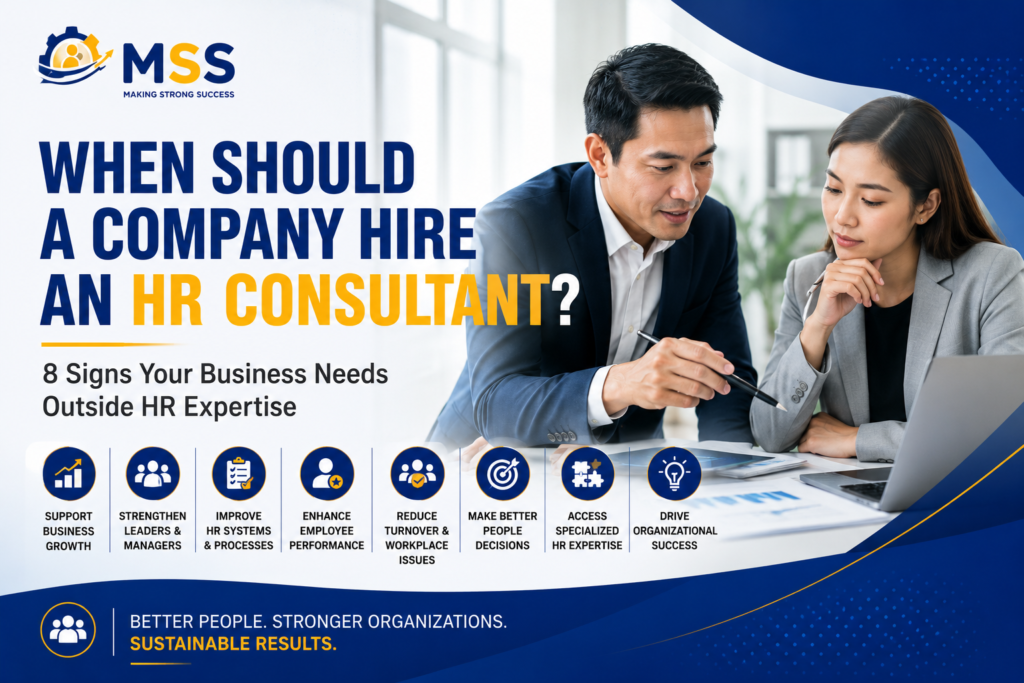
When should a company hire an HR consultant?
Hiring an HR consultant does not necessarily mean your internal HR team is ineffective. In many cases, organizations seek external HR expertise because they need specialized knowledge, an objective perspective, additional capacity, or support addressing challenges that go beyond day-to-day HR administration.
Here are eight signs that your organization may benefit from professional HR consulting services.
1. Your Business Is Growing Faster Than Your HR Systems
Business growth changes what an organization needs from HR.
Processes that worked for 20 employees may become difficult to manage with 50, 100, or more. Recruitment, onboarding, performance management, employee development, organizational structure, policies, and workforce planning all become more complex as headcount increases.
Without scalable HR systems, growth can create inconsistency and confusion.
An HR consultant can help assess whether your current people practices are ready to support the organization’s next stage of growth.
2. Your HR Team Is Constantly Handling Urgent Problems
When HR spends most of its time responding to immediate concerns, there may be little capacity left for strategic work.
Payroll concerns, recruitment requirements, employee relations, documentation, administrative tasks, and urgent management requests can consume the HR team’s attention.
These responsibilities matter, but HR must also contribute to longer-term priorities such as workforce planning, leadership development, organizational capability, succession, employee performance, and culture.
External HR consulting can provide additional expertise and capacity so organizations can address strategic priorities without neglecting daily operations.
3. Employee Performance Problems Keep Returning
Recurring performance issues are not always solved through another training program or another reminder from management.
Poor performance may be connected to unclear expectations, ineffective supervision, weak processes, inappropriate performance measures, capability gaps, organizational design, or insufficient accountability.
This is where an outside perspective can be valuable.
An HR consultant can help organizations examine the factors behind performance problems and determine whether the appropriate intervention involves training, coaching, performance management, process improvement, leadership development, or another organizational solution.
4. Your Policies and HR Practices Have Not Kept Up With the Business
Organizations evolve.
Roles change. Teams expand. New managers are appointed. Work arrangements change. Technologies are introduced. New business requirements emerge.
HR policies and practices should evolve with them.
When policies no longer reflect how the organization actually operates, employees and managers may receive inconsistent guidance.
A structured HR review can help identify areas that require clarification, improvement, or further professional and legal review where appropriate.
5. Managers Are Struggling to Manage People Effectively
Technical expertise does not automatically translate into people-management capability.
New and experienced managers alike may struggle with delegation, coaching, feedback, performance conversations, conflict management, employee motivation, or accountability.
When these challenges occur across several departments, the issue may require more than individual intervention.
HR consultants can help organizations assess leadership and management capability, identify development priorities, and design appropriate interventions for managers and leaders.
6. Turnover, Engagement, or Workplace Issues Are Affecting the Business
Employee turnover is sometimes treated as purely a recruitment problem.
But replacing employees without understanding why they leave can create an expensive cycle.
Compensation may be one factor, but employees may also leave because of poor management, unclear career opportunities, excessive workloads, ineffective communication, weak onboarding, workplace culture, or limited development opportunities.
External HR expertise can help organizations examine these issues more objectively and identify patterns that may not be obvious from individual cases.
7. Leadership Needs Objective Advice on People Decisions
Some workforce decisions are difficult precisely because leaders are deeply involved in the organization.
Internal familiarity is valuable, but it can also make it harder to challenge established practices or identify assumptions.
An external HR consultant can provide an independent perspective supported by assessment, structured analysis, professional experience, and organizational data.
This can be especially useful when reviewing organizational structures, workforce requirements, performance systems, leadership capabilities, HR strategies, or major organizational changes.
8. You Need Specialized HR Expertise but Not Necessarily Another Full-Time Position
Not every organization needs every HR specialization in-house.
A company may occasionally require expertise in areas such as:
- HR strategy
- Organizational development
- Performance management
- Workforce planning
- Competency development
- Training needs analysis
- Leadership development
- Organizational assessment
- HR systems and processes
Hiring a permanent specialist for every requirement may not always be practical.
HR consulting allows businesses to access specialized expertise based on the organization’s specific needs and priorities.
Internal HR and HR Consultants Can Work Together
The decision does not have to be internal HR versus external consultant.
They can complement each other.
Internal HR professionals understand the organization’s people, history, culture, and daily realities. External consultants can contribute specialized expertise, additional capacity, external benchmarks, structured methodologies, and a fresh perspective.
When both work together effectively, organizations can strengthen HR’s contribution to business performance.
What Should You Look for in an HR Consulting Partner?
Choosing an HR consultant should involve more than comparing proposals or training catalogs.
Organizations should consider whether the provider:
- Understands business as well as HR
- Diagnoses the problem before recommending a solution
- Can customize interventions to organizational needs
- Connects people initiatives with business objectives
- Has experience across training and consulting
- Focuses on sustainable solutions rather than temporary fixes
The objective should not simply be to outsource an HR activity.
It should be to strengthen the organization’s ability to manage, develop, and maximize its people.
HR Consulting Should Help the Business Perform Better
HR consulting creates the greatest value when it connects people decisions to organizational results.
The right interventions can help businesses strengthen leadership, improve workforce capability, establish more effective systems, address performance gaps, and prepare the organization for future growth.
Ultimately, the question is not simply:
“Do we need an HR consultant?”
A more useful question is:
“Do we currently have the expertise, systems, capacity, and perspective required to solve our people and organizational challenges effectively?”
If the answer is no—or not yet—external HR expertise may be the next strategic step.
Looking for HR Consulting and Organization & People Solutions?
MSS Corporation works with organizations that want to strengthen their people, leadership, systems, and organizational performance.
Through HR consulting, organizational development, customized corporate training, leadership development, assessments, coaching, strategic interventions, and other organization and people solutions, MSS helps businesses identify their actual needs and develop solutions aligned with their objectives.
Whether your organization has an established HR department, a growing HR team, or needs external expertise for a specific business challenge, MSS can work with you to determine the appropriate intervention.
Partner with MSS Corporation
If your organization is looking for a trusted partner in organization development, HR consulting, leadership development, and corporate training, MSS Corporation is ready to help.
Together, let’s build a workforce that is capable, confident, and future-ready.
If you enjoy reading, please visit our other articles for more interesting content.
To know more about Making Strong Success (MSS) Corporation, click our social media pages below: