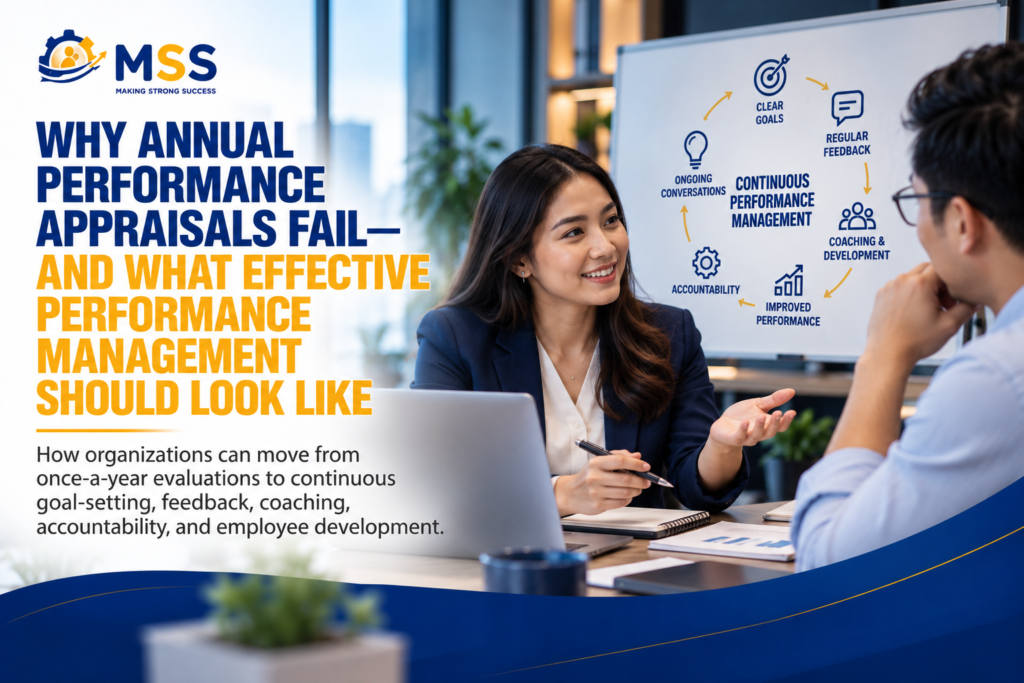
For many employees, performance management happens once a year.
A meeting is scheduled.
A form is opened.
The manager tries to remember what the employee accomplished over the previous several months.
Ratings are discussed. Strengths and weaknesses are documented. Development goals are written.
Then everyone returns to work.
And the performance appraisal is rarely discussed again until the next cycle.
The organization technically has a performance management process.
But is it actually managing performance?
An annual appraisal can be useful as part of a broader system. The problem begins when the annual review becomes the system itself.
Because employee performance doesn’t happen once a year.
It happens every day.
Performance Appraisal and Performance Management Are Not the Same Thing
These terms are sometimes used interchangeably, but there is an important distinction.
A performance appraisal is typically a formal evaluation of an employee’s performance during a defined period.
Performance management is broader.
It is an ongoing process for aligning expectations, monitoring progress, providing feedback, developing capability, addressing performance gaps, recognizing contributions, and connecting individual performance with organizational objectives.
In other words:
Performance appraisal evaluates performance.
Performance management helps create and improve performance.
Organizations need both—but the appraisal should be one component of the system rather than the entire system.
1. Employees Don’t Know What Success Looks Like
Performance problems often begin long before the annual review.
Employees may know their job responsibilities but still lack clarity about the results expected from them.
They are busy.
They complete tasks.
They attend meetings.
They respond to requests.
But do they understand what successful performance actually means?
Effective performance management begins with clear expectations.
Employees should understand:
- What results they are responsible for
- What priorities matter most
- How performance will be measured
- What behaviors are expected
- How their work contributes to team and organizational objectives
If expectations are unclear in January, a performance rating in December will not solve the problem.
2. Goals Are Set Once and Forgotten
Many organizations establish goals at the beginning of a performance cycle.
Then the business changes.
Priorities shift.
Customers change.
Projects are delayed.
New responsibilities emerge.
Yet employees may still be evaluated against goals established months earlier.
Effective performance management treats goals as living business commitments, not static entries in an appraisal form.
Managers and employees should periodically review whether goals remain relevant and adjust priorities when legitimate business conditions change.
The objective is not to constantly move the target.
It is to keep employee performance aligned with what the organization actually needs.
3. Feedback Arrives Too Late
Imagine an employee repeatedly making the same mistake for six months.
Then, during the annual appraisal, the manager finally says:
“This has been a problem all year.”
For the employee, the obvious question is:
“Why am I hearing about it now?”
Delayed feedback reduces the employee’s opportunity to correct behavior and improve results.
Effective managers address meaningful performance issues closer to when they occur.
That does not mean constantly criticizing employees.
It means creating a workplace where constructive feedback is a normal part of performance—not an annual surprise.
4. Managers Rely Too Much on Recent Events
Annual reviews can create a memory problem.
Managers may struggle to accurately recall an entire year of employee performance.
Recent successes or failures can disproportionately influence their judgment.
Highly visible projects may receive more attention than consistent everyday contributions.
This is one reason ongoing performance conversations matter.
Regular check-ins, appropriate documentation, measurable indicators, and observable examples can help create a more complete view of performance.
5. Employees Receive Ratings but Not Coaching
A rating tells someone where they were assessed.
It does not automatically tell them how to improve.
An employee who receives “Needs Improvement” still needs to understand:
What specifically needs to change?
Why does it matter?
What does better performance look like?
What support is available?
What should happen next?
Likewise, high-performing employees need development conversations too.
Strong performance today does not eliminate the need for future growth.
Effective performance management therefore combines evaluation with coaching and development.
6. Managers Avoid Difficult Performance Conversations
A performance management system is only as useful as the conversations managers are willing and able to have.
Some managers delay addressing performance issues because they fear conflict.
Others soften feedback until the message becomes unclear.
Some provide a rating without sufficient evidence.
Others focus exclusively on what went wrong.
Managers need the capability to communicate expectations, give constructive feedback, recognize performance, coach employees, document concerns, and hold people accountable appropriately.
This makes performance management not only an HR system issue—but also a leadership capability issue.
7. KPIs Measure Activity Instead of Results
Not everything that can be counted represents meaningful performance.
For example, measuring the number of calls made, meetings attended, reports submitted, or tasks completed may provide useful operational information.
But activity alone does not always demonstrate whether the employee produced the intended result.
Organizations need to ask:
What outcome is this role expected to influence or deliver?
Strong performance measures connect individual activity with meaningful outputs, outcomes, quality standards, customer requirements, team objectives, or business priorities.
Otherwise, employees can hit every number on a dashboard while the organization still misses what actually matters.
8. Everyone Is Rated the Same Way
Different roles create different types of value.
A salesperson, HR professional, accountant, operations manager, customer service representative, and executive should not necessarily be evaluated through identical measures.
Organizations need consistency in their performance philosophy and process.
But consistency does not require pretending that every job produces the same outcomes.
Performance measures should reflect the actual purpose and responsibilities of the role.
9. The System Focuses on Judgment Instead of Improvement
Employees may perceive performance appraisal as something that happens to them rather than something designed to help them succeed.
When the process centers almost entirely on ratings, employees can become defensive.
Managers can become uncomfortable.
HR can become preoccupied with completing forms on time.
The administrative process gets completed—but the developmental value disappears.
An effective system should answer more than: “How did this employee perform?”
It should also help answer: “What needs to happen for this employee to perform even better?”
10. There Is No Follow-Through After the Review
This may be the biggest weakness of all.
The employee and manager agree on development priorities.
An action plan is written.
Training is recommended.
Goals are established.
Then nothing happens.
A performance conversation without follow-through becomes documentation rather than management.
Organizations need mechanisms for managers and employees to revisit commitments, monitor progress, address barriers, and adjust development plans.
What Effective Performance Management Should Look Like
Performance management should be a continuous cycle rather than a once-a-year administrative event.
A practical cycle can look like:
Align → Set Expectations → Perform → Check In → Give Feedback → Coach → Evaluate → Develop → Realign
The annual or periodic formal review still has a place.
But by the time it happens, there should be few major surprises.
The employee and manager should already have discussed performance throughout the cycle.
Start With Alignment
Individual performance should connect to something larger.
Organizational strategy informs business priorities.
Business priorities inform departmental objectives.
Departmental objectives inform team goals.
Team goals inform individual responsibilities and performance expectations.
This creates a clearer line of sight:
Organization → Department → Team → Individual
Employees are more likely to understand the significance of their work when they can see how their contribution connects with organizational results.
Make Performance Conversations More Frequent
Continuous performance management does not necessarily mean holding lengthy formal reviews every week.
It can involve shorter, focused conversations.
Managers might regularly discuss:
- What support do you need?
- What’s going well?
- Where are you getting stuck?
- What has changed?
- What should you prioritize next?
- What feedback would help you improve?
The appropriate frequency will depend on the role, employee, organization, and nature of the work.
The principle is simple:
Don’t wait twelve months to manage today’s performance.
Separate Performance Problems From Capability Problems
When performance falls below expectations, organizations should diagnose why.
Does the employee lack knowledge or skill?
Are expectations unclear?
Is the process inefficient?
Are resources inadequate?
Does the employee lack authority?
Is the manager failing to provide direction?
Different causes require different interventions.
Training may solve a capability gap.
Coaching may help improve application.
Process redesign may remove barriers.
Role clarification may address confusion.
Performance management may strengthen accountability.
The right solution starts with the right diagnosis.
Develop Managers as Performance Leaders
HR can design an excellent performance-management system.
But managers bring that system to life.
Managers need to know how to:
- Establish expectations
- Translate goals into meaningful priorities
- Monitor progress
- Give timely feedback
- Recognize strong performance
- Coach employees
- Address performance gaps
- Conduct difficult conversations
- Document appropriately
- Create development plans
- Follow through
Without capable managers, even sophisticated performance-management technology can become little more than a digital form.
Use Performance Data to Make Better People Decisions
A mature performance-management system can generate useful organizational insights.
Leaders can identify:
- Recurring capability gaps
- High-performing employees
- Potential future leaders
- Development priorities
- Performance patterns across teams
- Areas requiring managerial support
- Roles with unclear expectations
- Workforce and succession risks
Performance information can therefore contribute to broader decisions involving training, talent management, succession planning, workforce planning, and organizational development.
MSS itself currently positions performance management, leadership development, assessments, employee engagement, and strategic HR solutions as connected components of its broader organization and people solutions. MSS Corporation
Performance Management Should Improve Performance
Organizations can spend significant time designing rating scales, appraisal forms, and evaluation schedules.
Those tools matter.
But the ultimate question is simpler: Does the system help people perform better?
If employees receive clearer expectations, managers provide better feedback, performance problems are addressed earlier, strong contributions are recognized, development becomes more targeted, and individual work becomes better aligned with business priorities, the system is doing something meaningful.
If everyone merely completes an annual form, the organization may have an appraisal process—but not necessarily an effective performance-management system.
How MSS Corporation Can Help
MSS Corporation helps organizations strengthen the connection between people performance and business performance through integrated Organization & People Solutions.
Depending on organizational needs, support can include performance-management system development, HR consulting, organizational development, leadership and management development, customized corporate training, coaching, competency development, organizational assessments, and 360-degree leadership and performance assessments.
MSS currently identifies performance management as part of its HR and consulting services and offers 360-degree assessment solutions that support leadership and employee development. MSS Corporation
The objective should not simply be to introduce another HR form.
It should be to build a performance culture where people understand expectations, receive useful feedback, take accountability, continue developing, and contribute meaningfully to organizational results.
Don’t Wait Until the Annual Review to Talk About Performance
Performance is happening now.
So should performance management.
Organizations that move beyond the once-a-year appraisal mindset can create clearer expectations, stronger managers, more meaningful development conversations, and greater accountability throughout the year.
The better question is no longer: “Have we completed our performance appraisals?”
It is: “Are we continuously helping our people perform at their best?”
Partner with MSS Corporation
If your organization is looking for a trusted partner in organization development, HR consulting, leadership development, and corporate training, MSS Corporation is ready to help.
Together, let’s build a workforce that is capable, confident, and future-ready.
If you enjoy reading, please visit our other articles for more interesting content.
To know more about Making Strong Success (MSS) Corporation, click our social media pages below: