Leading Sales, Leading People: Sales Management and Leadership Training Case Study in the Philippines
Kirkpatrick Level 3 Results Show Strong Workplace Behavior Transfer Among Retail Area Managers Approximately 100 Days After Training
What should companies look for when comparing training providers in the Philippines, training and consultancy companies in the Philippines, corporate training firms in the Philippines, or other professional learning partners?
One of the strongest indicators is what happens after the training ends.
Do participants actually use what they learned?
Do managers coach differently?
Do leaders communicate more clearly?
Do they manage performance more strategically?
Do they translate sales numbers into leadership actions?
And are those behaviors still visible several months after the program?
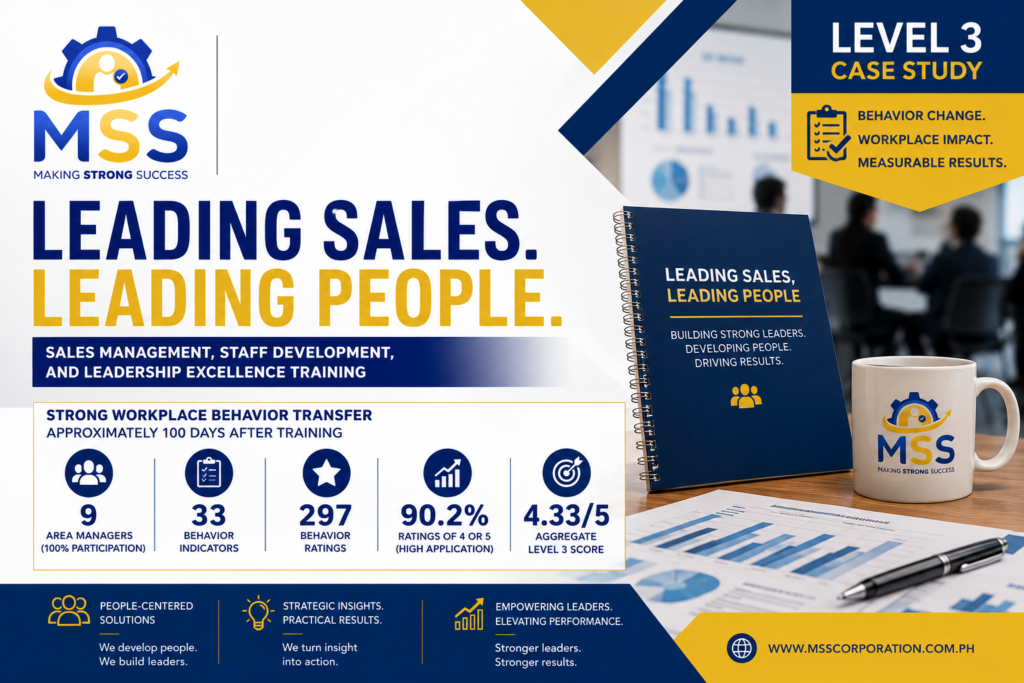
Making Strong Success (MSS) Corporation designed and delivered Leading Sales, Leading People, a customized one-day training program on Sales Management, Staff Development, and Leadership Excellence for Area Managers of Mendrez Shoes & Bags on October 22, 2025. The program was facilitated by a resident trainer-facilitator of ours and was designed to help Area Managers strengthen sales management while shifting from direct store oversight toward multi-branch leadership through Store Managers. The original program objectives included sales KPI management, coaching and feedback, people leadership, staff development, and action planning aligned with branch performance and company targets.
Approximately 100 days later, MSS conducted a Kirkpatrick Level 3 Transfer of Learning assessment.
The results showed strong sustained workplace application:
90.2% of all 297 behavior ratings were scored either 4 or 5—representing behaviors being applied at a high level approximately three months after training.
The aggregate behavior-transfer score was:
4.33 out of 5.00
And the strongest behavioral areas included communication across stores, coaching and mentoring, developmental leadership, clear action planning, and sales management through people.
For organizations searching for evidence-based training vendors in the Philippines or training consultants in the Philippines, the significance is simple:
The learning did not remain inside the classroom. Participants reported continuing to apply the targeted leadership and sales management behaviors roughly 100 days later.
Case Study at a Glance
| Case Study Element | Details |
|---|---|
| Program | Leading Sales, Leading People |
| Focus | Sales Management, Staff Development and Leadership Excellence |
| Client | Filipino retail brand is well-known for offering stylish, affordable, and durable footwear and accessories designed for everyday wear. |
| Industry | Philippine retail footwear and fashion |
| Participants | Area Managers |
| Actual Level 3 Respondents | 9 |
| Response Rate | 100% of actual trainees |
| Training Date | October 22, 2025 |
| Delivery | 1-day face-to-face customized corporate training |
| Facilitator | Coach Eckhon Malig |
| Level 3 Survey Period | January 29–February 1, 2026 |
| Days After Training | 99–102 days |
| Behavior Indicators | 33 |
| Individual Behavior Ratings | 297 |
| Aggregate Behavior Score | 4.33 / 5.00 |
| Ratings of 4 or 5 | 90.2% |
| Evaluation Framework | Kirkpatrick Level 3 — Behavior / Transfer of Learning |
| Evaluation Method | Participant self-assessment + qualitative feedback |
The formal evaluation described the overall result as “Strong Transfer of Learning” and reported a high level of behavior application across leadership, sales management, and staff development.
The Short Answer: Did the Training Change Workplace Behavior?
Based on the Level 3 participant self-assessment:
Yes—strong behavior transfer was reported approximately 100 days after training.
Across the 297 individual ratings:
- 129 ratings or 43.4% received a 5
- 139 ratings or 46.8% received a 4
- 26 ratings or 8.8% received a 3
- only 3 ratings or 1.0% received a 2
- 0 ratings received a 1
Therefore:
268 out of 297 ratings—or 90.2%—were rated 4 or 5.
The overall average was:
4.33 / 5.00
This is significant because the evaluation was not conducted immediately after participants completed the workshop.
The Area Managers had already spent approximately three months returning to their branches, dealing with actual sales targets, Store Managers, operational issues, performance gaps, customer demands, competing priorities, and the realities of multi-store leadership.
The assessment therefore asked a much stronger question than:
“Did you enjoy the seminar?”
It examined:
“Are you still doing the behaviors the training was designed to develop?”
The Business Challenge: From Store Oversight to Multi-Branch Leadership
The role of an Area Manager creates a unique leadership challenge.
An effective Store Manager may succeed by directly managing the people and operations in one location.
An Area Manager cannot simply multiply that behavior across several branches.
As responsibility expands, the Area Manager must increasingly lead through other leaders.
That requires a transition from:
personally fixing problems
to:
developing Store Managers who can solve problems.
From:
checking everything personally
to:
setting standards, creating accountability, and reviewing results.
From:
managing sales purely as numbers
to:
understanding how leadership, coaching, engagement, execution, and employee behavior influence those numbers.
The program was therefore designed to help Area Managers strengthen multi-branch leadership while simultaneously improving sales management discipline.
The proposal specifically identified their role in balancing sales performance, staff development, and brand consistency, while equipping them to drive branch sales, coach Store Managers, and lead people more effectively.
The Training Intervention: “Leading Sales, Leading People”
The one-day intervention integrated sales management and people leadership rather than treating them as unrelated competencies.
The learning architecture covered five major areas.
1. Sales Management and Commercial Discipline
Participants worked with practical retail sales indicators such as:
- Conversion;
- Basket size;
- Upselling;
- Sales report interpretation;
- Trend identification;
- and Alignment of multiple stores with daily and weekly performance targets.
The program deliberately connected sales data with decisions rather than using reports merely for compliance.
2. Staff Management and Leadership
The program reinforced the shift toward:
- Managing through Store Managers;
- Communicating effectively across leadership levels;
- Creating trust and respect;
- and Handling performance gaps constructively.
3. Coaching and Mentoring
Participants practiced:
- Structured coaching;
- Constructive feedback;
- Mentoring for longer-term development;
- and Helping Store Managers strengthen their own sales-leadership capability.
The workshop design included coaching and mentoring practice rather than relying only on lectures.
4. Driving Sales Through People
The intervention connected sales performance with:
- Employee engagement;
- Accountability;
- Ownership;
- Morale;
- and Leadership presence.
This helped reinforce the principle that sales management is not simply spreadsheet management.
5. Action Planning
The program concluded with commitment setting so that participants could identify concrete actions to cascade into their stores.
The intervention used role-plays, simulations, case studies, KPI analysis, workshops, and action planning, giving Area Managers opportunities to practice before returning to the workplace.
Kirkpatrick Level 3 Result: Strong Transfer Across 33 Leadership and Sales Behaviors
The customized Level 3 survey assessed 33 specific workplace behaviors.
For public analysis, these behaviors can be organized into seven interconnected areas:
- Leadership role clarity and delegation
- Standards, accountability and follow-through
- Data-driven leadership
- Communication across stores
- Leadership presence and recognition
- Coaching and mentoring
- Sales management through people
The combined result across all 33 indicators was:
4.33 / 5.00
with:
90.2% of all responses rated 4 or 5.
The internal Level 3 report similarly concluded that the program produced meaningful behavioral change and strengthened leadership mindset, staff-development practices, people-led sales management, and proactive leadership.
Result 1: Communication Across Stores Became the Strongest Consistent Behavior
One of the clearest findings concerned leadership communication.
Across five related communication behaviors, the average was:
4.53 / 5.00
And most notably:
100% of all ratings in this competency group were 4 or 5.
The behaviors included:
- Communicating instructions consistently across stores;
- Giving clear and simple directions;
- Maintaining a calm professional tone during pressure;
- Explaining what needs to happen, why it matters, and when it is due;
- and Adapting communication appropriately for Store Managers versus frontline employees.
This is especially important in multi-branch leadership.
A message that changes from one store to another can create:
- Inconsistent execution;
- Confusion;
- Misaligned priorities;
- Perceived unfairness;
- and Varying customer experiences.
Area leadership therefore depends heavily on consistency and clarity.
Result 2: “What, Why and When” Became One of the Highest-Rated Leadership Behaviors
One of the strongest individual survey statements was:
Explaining what needs to be done, why it matters, and when it is due.
Average:
4.67 / 5.00
Ratings of 4 or 5:
100%
This matters because instructions are often incomplete.
A manager may communicate what needs to happen without explaining:
why it matters
or:
when completion is expected.
Clear leadership communication reduces ambiguity and makes accountability easier.
Result 3: Coaching and Mentoring Showed Exceptional Transfer
The coaching and mentoring behaviors generated one of the strongest competency results.
Average:
4.56 / 5.00
High application ratings:
97.8% rated 4 or 5
Participants reported strong application of behaviors such as:
- Coaching for improvement rather than blame;
- Asking questions that help managers think through their goals and current realities;
- Helping Store Managers explore options;
- Turning coaching discussions into clear actions and timelines;
- and Balancing short-term performance coaching with longer-term development.
This aligns strongly with the formal report, which noted visible coaching conversations, constructive feedback, developmental guidance, earlier management of performance gaps, and coaching around conversion, basket size, and upselling.
Result 4: Coaching Became More Developmental Than Directive
One of the program’s intended shifts was to help Area Managers move away from solving every problem themselves.
Instead, they were encouraged to help Store Managers think.
Two related behaviors achieved the highest individual averages in the survey:
Helping managers explore options before deciding on actions
4.67 / 5.00
100% rated 4 or 5
Supporting Store Managers in establishing clear action steps and timelines
4.67 / 5.00
100% rated 4 or 5
These behaviors reflect a deeper leadership principle:
Developing leaders requires more than giving them answers.
Managers become stronger when leaders help them build their own problem-solving capability.
Result 5: Sales Management Was Increasingly Connected With People Leadership
The Level 3 assessment examined whether participants were applying behaviors such as:
- Using sales data to identify gaps and opportunities;
- Coaching Store Managers on conversion, basket size, and upselling;
- Encouraging initiatives beyond discounting;
- Proactively addressing underperforming stores;
- and Connecting engagement, coaching, and leadership presence with sales results.
Across these sales-management-through-people behaviors:
88.9% of ratings were 4 or 5
with an average of:
4.36 / 5.00
One particularly important behavior was:
Linking people behavior—such as engagement, coaching and leadership presence—to sales results.
That behavior achieved:
4.33 / 5.00
with:
100% of respondents rating themselves 4 or 5.
The formal evaluation reached a similar conclusion: Area Managers were increasingly connecting people behavior with sales performance, encouraging initiatives beyond discounts, and addressing underperformance more proactively.
Result 6: Area Managers Reported More Proactive Leadership
The qualitative findings also indicated a shift from reacting to problems after they became serious toward addressing them sooner.
The formal Level 3 report identified:
- earlier and more decisive responses to issues;
- stronger problem-solving orientation;
- and greater consistency in addressing underperforming stores.
This is important because multi-branch leadership requires Area Managers to recognize patterns early.
A small issue in one store may be isolated.
The same issue appearing across several stores may indicate a:
- Capability problem;
- Process problem;
- Leadership problem;
- Communication problem;
- or Broader commercial issue.
The role of the Area Manager is therefore increasingly diagnostic, not merely operational.
Result 7: Data-Driven Leadership Was Being Applied
The training also reinforced the use of business information in leadership conversations.
The Level 3 survey measured whether Area Managers were:
- reviewing sales figures and conversion data;
- using information rather than assumptions;
- and treating verification as a leadership discipline rather than fault-finding.
Across the related indicators, the average was approximately:
4.30 / 5.00
with:
88.9% of ratings at 4 or 5.
The strongest behavior within this group involved regularly reviewing sales figures, conversion results, and performance reports.
Average:
4.44 / 5.00
Ratings of 4 or 5:
100%
This reinforces the connection between leadership and commercial accountability.
Result 8: Leadership Presence and Modeling Remained Strong
The assessment also examined whether Area Managers:
- Modeled expected standards;
- Remained accessible when Store Managers needed support;
- Followed through on commitments;
- Recognized strong performance;
- and Corrected performance issues respectfully.
The overall average for these behaviors was approximately:
4.29 / 5.00
The findings suggest that Area Managers were generally demonstrating visible leadership rather than relying entirely on positional authority.
The Biggest Development Opportunity: Fully Shifting From “Doing” to “Developing”
The results were strong, but they also revealed a highly useful development opportunity.
One of the program’s central objectives was to move Area Managers from:
“I solve the problem.”
toward:
“I develop Store Managers who can solve the problem.”
The related statement:
“Demonstrates a clear shift from doing the work to developing leaders”
received an average of:
4.00 / 5.00
with:
66.7% rating themselves 4 or 5.
This was positive—but lower than most other behaviors.
Similarly, the broader leadership role clarity and delegation cluster averaged approximately:
4.06 / 5.00
with:
80.6% of ratings at 4 or 5.
This tells us something important.
The training appears to have strengthened leadership behaviors, but the transition from operational problem-solver to true leader-of-leaders requires ongoing reinforcement.
That is normal.
Delegating responsibility without abandoning accountability is one of the more difficult transitions in management.
Another Opportunity: Making Performance Feedback More Quantitative
The lowest-rated individual behavior was:
Using specific performance indicators instead of vague feedback such as “do better.”
Average:
3.78 / 5.00
Ratings of 4 or 5:
77.8%
This remains a positive score, but it highlights an important next-stage development area.
A manager telling someone:
“Improve sales.”
provides very little actionable guidance.
A stronger conversation might examine:
- Conversion;
- Basket size;
- Upsell ratio;
- Traffic;
- Individual selling behaviors;
- Time periods;
- Trends;
- and Specific performance gaps.
The next stage of development should therefore continue connecting coaching conversations with measurable indicators.
Qualitative Findings: What Changed in Actual Leadership Practice?
The open-ended survey feedback reinforced several quantitative patterns.
To protect respondents, individual comments are not reproduced verbatim here.
Recurring themes included:
Clearer Communication
Participants described becoming more intentional and understandable when communicating expectations and responsibilities.
Regular Coaching
Coaching conversations became more visible, particularly around goals, sales performance and confidence.
More Constructive Feedback
Feedback was increasingly framed around development and improvement.
Greater Trust and Delegation
Some Area Managers reported placing more responsibility in Store Managers while maintaining appropriate oversight.
More Proactive Problem-Solving
Leaders described addressing concerns earlier and encouraging teams to participate in developing solutions.
Greater Accountability
Respondents referred to stronger focus on responsibilities, ownership and follow-through.
More Calm and Respectful Leadership
Communication tone, patience and respectful handling of performance issues also emerged as recurring leadership practices.
These findings are consistent with the report’s conclusion that Area Managers were demonstrating a transition toward more developmental, proactive leadership.
What Still Needed Reinforcement Approximately 100 Days Later?
A credible Level 3 case study should not publish only the strongest findings.
The evaluation identified several areas where continued development could strengthen behavior transfer further.
1. Consistency During High-Pressure Periods
Some participants indicated that maintaining coaching and leadership behaviors consistently becomes more difficult when operational pressure increases.
2. Time Management
Balancing:
coaching + performance monitoring + administrative responsibilities
remained challenging for some Area Managers.
3. Recognition and Positive Reinforcement
Participants identified opportunities for:
- More frequent recognition;
- and Stronger reinforcement of positive store-level performance.
The formal Level 3 report specifically identified these three development priorities.
What Additional Support Did Participants Request?
The participants’ recommendations largely pointed toward reinforcement, rather than suggesting the original training had failed.
Requested support included:
- regular coaching or follow-up sessions;
- additional sales-focused training for Store Managers;
- team building interventions;
- ongoing feedback mechanisms;
- practical monitoring tools;
- and additional opportunities to strengthen leadership application.
The formal evaluation likewise recommended continuing coaching, Store Manager development, recognition frameworks, and eventually measuring Level 4 business impact.
Overall Leadership Effectiveness Approximately Three Months Later
The Level 3 survey also asked participants to provide an overall rating of improvement in leadership effectiveness.
Eight participants supplied a numerical rating.
Their average was:
4.00 / 5.00
And:
87.5% of those numerical ratings were 4 or 5.
This provides an additional overall indicator alongside the detailed 33-behavior assessment.
It should still be interpreted as self-reported improvement rather than an independently observed causal effect.
Did Participants Want Further Leadership Development?
Among the substantive responses to the question on additional leadership coaching and development:
6 of 7 respondents supported further development
while one respondent indicated that additional coaching was not necessary.
This is consistent with the internal report’s finding that respondents largely perceived continued coaching and development as valuable.
The implication is important:
Strong Level 3 transfer does not mean development should stop.
It means reinforcement can build on behaviors that are already taking hold.
What These Level 3 Results Do Not Prove
Evidence-based corporate training case studies should distinguish behavior transfer from business impact.
This evaluation used:
- participant self-assessment;
- quantitative behavior ratings;
- and qualitative feedback.
It did not, within the evidence used for this case study, include:
- independently observed leadership behavior;
- matched Store Manager ratings;
- mystery shopping results;
- pre-training versus post-training branch conversion data;
- basket size comparisons;
- upsell ratio comparisons;
- revenue attribution;
- a control group;
- retention analysis;
- or financial ROI calculations.
Therefore, this case study provides evidence of:
Reported Kirkpatrick Level 3 Behavior Transfer
It does not establish that the training alone caused a specific:
- sales increase;
- revenue uplift;
- store performance improvement;
- retention result;
- or ROI.
Those questions belong to a future Level 4 business impact evaluation, which the internal report also recommends.
That distinction strengthens the credibility of the case study because the evidence is presented according to what it actually demonstrates.
What This Case Study Shows About Effective Corporate Training
Approximately 100 days after a single one-day intervention:
- 9 Area Managers participated in the Level 3 evaluation;
- They represented 100% of actual trainees;
- 33 behaviors were evaluated;
- 297 individual behavior ratings were analyzed;
- 90.2% of those ratings were 4 or 5;
- The aggregate behavior transfer score was 4.33 / 5.00;
- Communication across stores achieved 100% high application ratings;
- Coaching and mentoring averaged 4.56 / 5.00;
- and Several core coaching and action planning behaviors achieved 4.67 / 5.00.
The internal assessment consequently concluded that the training strengthened leadership mindset, staff development, people-led sales management, and proactive leadership.
For a one-day corporate training intervention, that is a meaningful post-training evidence base.
Why This Matters When Choosing Training Providers in the Philippines
Companies searching for training providers in the Philippines should look beyond the training-day experience.
The same is true when evaluating:
training and consultancy companies in the Philippines,
training and consultancy firms in the Philippines,
training vendors in the Philippines,
corporate training companies in the Philippines,
corporate training firms in the Philippines,
or independent training consultants in the Philippines.
A professional learning partner should be prepared to answer questions such as:
What behaviors are expected to change?
How will participants practice those behaviors?
What should managers reinforce afterward?
How will transfer of learning be evaluated?
Which behaviors improved most?
Which behaviors still need reinforcement?
And how can Level 3 eventually connect with business-performance measures?
At MSS Corporation, training evaluation increasingly goes beyond:
“Did participants enjoy the program?”
toward:
Learning → Application → Behavior → Performance
Why MSS Corporation Designed Sales and Leadership Together
One of the most important lessons from this engagement is that sales management and people leadership should not always be treated as separate development topics.
A multi-branch retail leader influences sales through:
- The standards they communicate;
- The Store Managers they develop;
- The questions they ask;
- The data they review;
- The behaviors they recognize;
- The issues they address;
- The accountability they establish;
- and The culture they create.
That is why Leading Sales, Leading People integrated:
sales management + coaching + staff development + leadership excellence.
The objective was not merely to create Area Managers who could read sales reports.
It was to help develop leaders who could use:
People + Data + Coaching + Accountability + Execution
to influence multi-store performance.
Looking for Sales Management or Leadership Training in the Philippines?
MSS Corporation designs customized corporate learning interventions for organizations that need to strengthen:
- Sales leadership;
- Sales management;
- Frontline management;
- Supervisory capability;
- Coaching;
- Performance management;
- Staff development;
- Leadership communication;
- Accountability;
- Team development;
- and People management.
Rather than simply delivering generic course content, programs can be customized around the client’s:
- Industry;
- Organizational structure;
- Sales process;
- Management levels;
- Performance indicators;
- Operating realities;
- Leadership challenges;
- and Expected workplace behaviors.
For organizations comparing corporate training companies in the Philippines or looking for a training and consultancy firm in the Philippines, the question should not only be:
“What topics can you teach?”
A stronger question is:
“What behaviors can this intervention help our people actually apply?”
Frequently Asked Questions
What is Kirkpatrick Level 3 training evaluation?
Kirkpatrick Level 3 evaluates whether participants apply intended behaviors in their workplace after training.
In this engagement, the Level 3 survey focused on actual leadership, coaching, communication, accountability and sales management behaviors rather than knowledge recall or training satisfaction. The formal methodology explicitly identifies the instrument as a customized self-assessment using a 1-to-5 application scale.
How long after the training was this Level 3 evaluation conducted?
The raw responses were collected between January 29 and February 1, 2026, or approximately 99–102 days after the October 22, 2025 training.
How many Area Managers participated?
Nine Area Managers completed the evaluation, representing 100% of the actual trainees, according to the formal report.
How many workplace behaviors were evaluated?
The questionnaire contained 33 quantitative behavior indicators, generating 297 individual behavior ratings across the nine respondents.
What was the overall Level 3 result?
The calculated aggregate score was 4.33 out of 5.00, with 90.2% of all behavior ratings at 4 or 5.
Which behaviors showed the strongest transfer?
Several behaviors averaged 4.67 out of 5.00, including:
- Clearly communicating what needs to happen, why it matters and when it is due;
- Helping Store Managers explore options before making decisions;
- and Helping Store Managers translate coaching conversations into clear actions and timelines.
What was the strongest competency area?
Communication across stores was especially strong, with an aggregate average of approximately 4.53 out of 5.00 and 100% of related ratings at 4 or 5.
Coaching and mentoring also performed strongly at approximately 4.56 out of 5.00.
What still needed improvement?
The clearest opportunities included:
- Continuing the shift from operational problem-solving toward leader development;
- More specific use of measurable performance indicators in feedback;
- Consistent coaching during high-pressure periods;
- Time management;
- and More frequent recognition and positive reinforcement.
Does this prove that the training increased sales?
No.
The evaluation supports reported Level 3 workplace behavior transfer. It does not independently prove that training caused higher revenue or store sales. A Level 4 evaluation incorporating verified business indicators would be required for those conclusions.
What should companies look for when choosing training vendors in the Philippines?
Companies should consider:
- Customization;
- Facilitator expertise;
- Practical application;
- Industry relevance;
- Behavioral objectives;
- Post-training reinforcement;
- Training evaluation;
- and Evidence that learning transfers to the workplace.
Does MSS Corporation customize sales and leadership training?
Yes. MSS Corporation develops corporate learning interventions around the client’s actual workforce, leadership structure, sales environment, challenges, performance requirements and desired workplace behaviors.
Methodology and Evidence-Integrity Note
This case study is based on a customized Kirkpatrick Level 3 Transfer of Learning assessment involving nine Area Managers, representing 100% of actual trainees. The formal report states that the survey used a 1 = Not Applied to 5 = Consistently Applied scale and combined quantitative responses with qualitative open-ended feedback.
The raw dataset contained:
- 9 respondents
- 33 quantitative behavior statements
- 297 behavior ratings
- Qualitative questions regarding observed changes, visible practices, reinforcement needs and additional support
- An overall leadership effectiveness item
- and A further development recommendation item.
For this public analysis:
- Ratings of 4 and 5 were treated as high workplace application;
- All valid behavior ratings were included;
- Related behaviors were grouped analytically into leadership, communication, coaching, accountability, data and sales-management themes;
- Qualitative responses were synthesized into themes rather than quoted individually;
- and The evidence is characterized as self-reported Level 3 transfer, not independently verified Level 4 business impact.
No participant names or personally identifying respondent information should be included in the published version.
About Making Strong Success (MSS) Corporation
Making Strong Success (MSS) Corporation is an organization and people solutions provider offering customized corporate training, consulting, coaching, facilitation, organizational development and related professional services in the Philippines.
MSS works with organizations to connect capability building with practical workplace application.
For companies evaluating training and consultancy companies in the Philippines, corporate training firms in the Philippines, or other learning and development partners, our objective is not simply to conduct a training event.
It is to help organizations create stronger:
leaders, managers, teams, systems, behaviors and results.
Request a Customized Sales Management or Leadership Training Program
If your organization needs to develop sales managers, Area Managers, Store Managers, supervisors, team leaders or other people managers, MSS Corporation can customize a learning intervention around your actual business environment.
Talk to MSS Corporation about a customized Sales Management, Leadership, Coaching, Staff Development or Performance Management program in the Philippines.