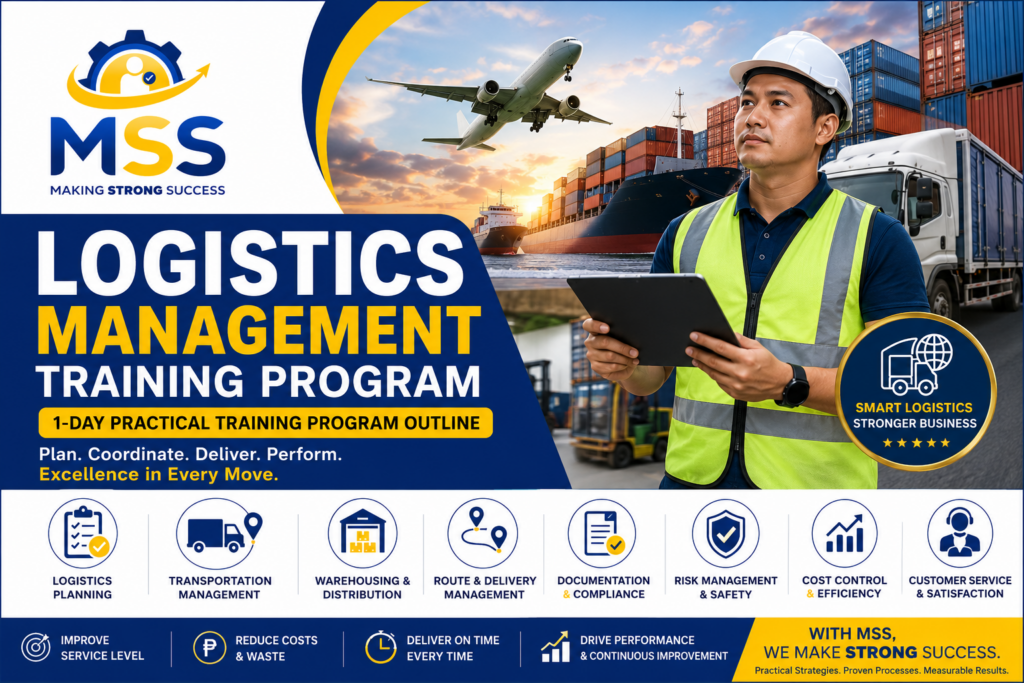
Logistics Management Training Program Outline
Explore our 1-day Logistics Management Training in the Philippines, a practical and highly interactive program designed to help logistics managers, supervisors, coordinators, transport personnel, dispatch teams, warehouse employees, purchasing staff, supply-chain professionals, customer service teams, project coordinators, and operations personnel improve delivery performance, cost efficiency, coordination, visibility, and service reliability.
Effective logistics management goes beyond arranging vehicles or monitoring deliveries. It requires the coordinated movement of products, materials, documents, information, and resources from the point of origin to the correct destination at the required time, quantity, condition, service level, and cost.
Organizations searching for Managing Logistics Training in the Philippines, Logistics Training in the Philippines, or Training on Logistics in the Philippines will find this program especially relevant. It addresses common logistics challenges such as delayed deliveries, poor route planning, underused vehicle capacity, incomplete documents, weak shipment visibility, high freight costs, failed delivery attempts, damaged goods, uncontrolled returns, inconsistent carrier performance, and poor coordination among Sales, Warehouse, Purchasing, Finance, Operations, and Customer Service.
Participants learn how to manage the complete logistics process, including:
- Logistics planning and requirement confirmation
- Transportation-mode selection
- Route, load, and delivery scheduling
- Warehouse and dispatch coordination
- Shipment monitoring and customer updates
- Delivery documentation and proof of delivery
- Third-party logistics and carrier management
- Logistics cost analysis and control
- Risk identification and contingency planning
- Reverse logistics and returns management
- Delivery performance measurement
- Logistics KPIs and continuous improvement
The training also helps participants understand how service requirements, lead time, capacity, product characteristics, destination, risk, documentation, customer expectations, and total logistics cost must be considered together when making logistics decisions.
Using the MSS EnterTRAINment approach, the program combines concise discussions, logistics-flow mapping, transport-planning exercises, route and delivery challenges, cost-analysis activities, carrier-evaluation scenarios, documentation reviews, risk simulations, reverse-logistics exercises, KPI workshops, team activities, and workplace action planning.
The embedded PDF below contains the complete Logistics Management Training in the Philippines program outline, including the training overview, learning objectives, full-day agenda, practical modules, experiential activities, participant outputs, transportation and distribution principles, delivery-control practices, logistics cost considerations, risk-management tools, frequently asked questions, and recommended follow-through programs.
This training helps logistics teams move from reactive and last-minute delivery practices toward structured planning, coordinated execution, stronger shipment visibility, disciplined cost control, reliable service-provider management, and continuously improving logistics performance.
To check out our other relevant training programs, click the link below:
Supply Chain Management Programs
To know more about Making Strong Success (MSS) Corporation, visit our social media pages at: