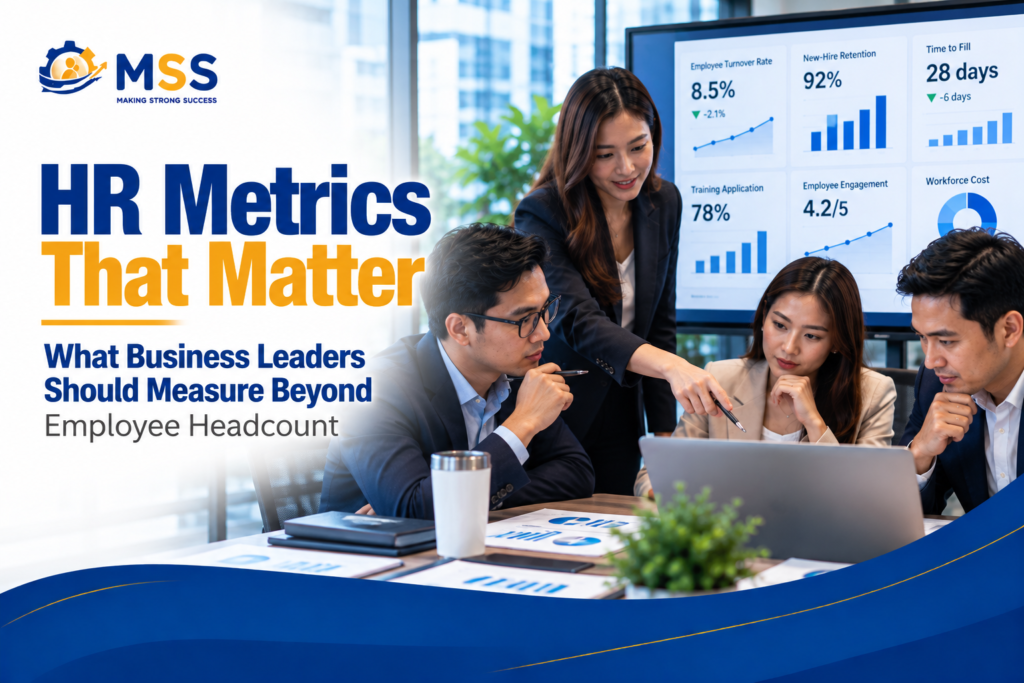
How Philippine companies can use workforce data, people analytics, and meaningful HR indicators to make better decisions about employees, performance, and business growth.
Your Company Knows How Many Employees It Has. But What Does That Number Really Tell You?
Ask a business leader how many employees the company has, and the answer is usually available.
Ask how many employees are leaving, how quickly new hires become productive, which departments are experiencing workforce problems, or whether training investments are improving performance—and the answers may be less clear.
Many organizations collect substantial amounts of HR information.
They maintain employee records, process payroll, track attendance, document recruitment, conduct performance evaluations, and organize training programs.
But collecting information is not the same as using it to make better decisions.
A company may have hundreds of employees and still struggle with productivity. Another may have relatively low turnover but experience the repeated loss of critical talent. A third may conduct numerous training programs without knowing whether workplace performance has improved.
These situations reveal an important distinction:
Employee headcount tells you how many people work for your organization. Meaningful HR metrics help you understand what is happening to your workforce and what management may need to do about it.
For Philippine companies seeking sustainable growth, HR metrics and people analytics can help connect workforce realities with business priorities.
The objective is not to produce more reports. It is to turn relevant HR information into practical management decisions.
What Are HR Metrics?
HR metrics are quantitative measures used to monitor and evaluate aspects of an organization’s workforce and human resource management practices.
They can help organizations understand patterns involving recruitment, retention, attendance, workforce capacity, employee development, performance, and other people-related activities.
Common examples include:
- Employee turnover rate
- Employee retention rate
- Time to fill vacancies
- New-hire retention
- Absenteeism rate
- Training completion and application
- Internal promotion rate
- Workforce costs
- Employee engagement indicators
- HR service delivery measures
However, not every HR metric is equally valuable to every organization.
A growing service company may need to prioritize recruitment capacity and employee retention.
A manufacturing company may be more concerned with workforce availability, skills coverage, and operational continuity.
A professional services organization may focus on capability development, employee utilization, and critical talent retention.
The right metrics depend on the business model, organizational objectives, and management decisions they are intended to support.
HR Metrics vs. People Analytics: What Is the Difference?
Although the terms are related, they are not exactly the same.
HR metrics describe measurable aspects of the workforce.
For example, a company might report that its employee turnover rate increased from 10% to 15%.
People analytics goes further by examining patterns, relationships, and possible explanations behind workforce outcomes.
The organization might investigate whether turnover is concentrated in particular departments, employee tenure groups, job roles, or management teams.
It could then compare those patterns with employee feedback, workload changes, compensation practices, or other relevant factors.
This analysis does not automatically establish why employees leave.
But it can help leadership develop better questions, test assumptions, and identify areas requiring investigation.
The goal is to move from simply reporting numbers to understanding what those numbers mean for the business.
Why Employee Headcount Alone Is Not Enough
Headcount is an important workforce planning measure.
It helps organizations understand staffing levels, budget requirements, reporting relationships, and workforce distribution.
But headcount does not reveal whether employees are appropriately deployed, sufficiently skilled, engaged, or able to deliver expected results.
Consider two departments with 20 employees each.
Department A consistently meets its targets, experiences manageable workloads, and retains key employees.
Department B regularly misses deadlines, struggles with turnover, and depends heavily on overtime.
Both departments have the same headcount.
But their workforce conditions and operational challenges are different.
Simply adding employees to Department B may not solve the underlying problem.
Management may need to investigate workload distribution, skills, processes, leadership practices, or role design.
This is why workforce decisions should consider both the number of employees and the organizational conditions affecting their performance.
10 HR Metrics Business Leaders Should Understand
The following metrics provide a practical starting point for companies seeking better visibility into workforce conditions.
They should be selected and interpreted according to organizational priorities, not treated as a universal scorecard.
1. Employee Turnover Rate
What it measures: The proportion of employees who leave an organization during a defined period.
A commonly used calculation is:
Employee Turnover Rate = (Number of Employee Separations ÷ Average Employee Headcount) × 100
For example, if 12 employees leave during a year and the average workforce is 120 employees, the annual turnover rate is 10%.
Why it matters:
Turnover can affect recruitment expenses, knowledge continuity, workload distribution, and operational stability.
However, an overall turnover rate does not tell the complete story.
Organizations should also examine whether departures are voluntary or involuntary, which roles are affected, and whether employees are leaving during their first year.
Management question: Are we losing employees in areas that could affect business continuity or future capability?
2. Employee Retention Rate
What it measures: The proportion of employees from a defined starting group who remain employed at the end of a specified period.
One useful calculation is:
Retention Rate = (Employees From the Starting Group Still Employed at Period End ÷ Employees in the Starting Group) × 100
New hires during the period should not be added to the retained starting group.
Why it matters:
Retention analysis helps organizations understand workforce stability and identify groups requiring closer attention.
It may be particularly useful when examining new-hire retention, critical roles, or employees with specialized capabilities.
Management question: Which employee groups are we retaining successfully, and where are we experiencing avoidable losses?
3. Time to Fill Vacancies
What it measures: The number of days required to fill an approved position.
Organizations should define a consistent starting point, such as the date a vacancy is approved, and an ending point, such as offer acceptance.
Why it matters:
Extended vacancies can affect workload, service delivery, and business expansion.
However, a shorter hiring process is not necessarily better if it compromises candidate quality or role fit.
Time-to-fill data should therefore be considered alongside recruitment outcomes.
Management question: Are recruitment delays affecting operations, and where in the hiring process do those delays occur?
4. New-Hire Retention and Onboarding Outcomes
What it measures: Whether newly hired employees remain with the organization and achieve appropriate early performance milestones.
Potential indicators include:
- New-hire retention after 90 days
- Completion of essential onboarding requirements
- Achievement of role-specific readiness milestones
- Manager assessment of early performance
- New-hire feedback about expectations and support
Why it matters:
Hiring success should not be evaluated only by whether a vacancy has been filled.
Organizations should also consider whether new employees receive the preparation, resources, and management support needed to succeed.
Management question: Are our recruitment and onboarding practices producing employees who are prepared to perform?
5. Absenteeism Rate
What it measures: The proportion of scheduled working time lost to defined categories of absence.
One possible calculation is:
Absenteeism Rate = (Absence Days ÷ Total Scheduled Workdays) × 100
The organization must clearly define which absences are included and use consistent rules.
Approved leave, legally protected absences, and other categories should not be interpreted indiscriminately as performance problems.
Why it matters:
Absence patterns can affect workforce availability, scheduling, workload distribution, and operational continuity.
However, the numbers alone cannot establish the reasons for absences.
Management question: Are recurring workforce availability patterns affecting operations, and what additional information is needed to understand them?
6. Training Application and Capability Development
What it measures: Whether employees are developing and applying capabilities relevant to their roles.
Training attendance and completion are useful administrative measures, but they do not necessarily demonstrate workplace improvement.
Organizations may also examine:
- Demonstrated competency improvement
- Application of learning after training
- Manager-observed behavior changes
- Achievement of relevant performance milestones
- Closure of identified capability gaps
Why it matters:
Training is an investment in workforce capability.
Its effectiveness should be assessed in relation to the learning objectives and the workplace behaviors the organization expects to improve.
Management question: Are our development programs building capabilities that employees actually use?
7. Employee Engagement Indicators
What they measure: Employee perceptions and experiences related to work, leadership, communication, support, and organizational conditions.
These may be assessed through appropriately designed employee surveys, pulse checks, or structured feedback mechanisms.
Why they matter:
Employee feedback can reveal concerns that may not be visible through operational reports alone.
However, engagement survey results should be interpreted carefully.
A high score does not automatically guarantee strong performance, and a low score does not identify a single root cause.
Management question: What are employees telling us about the conditions that help or prevent them from doing their work effectively?
8. Internal Promotion and Talent Mobility
What it measures: How employees move into new roles or opportunities within the organization.
Relevant indicators may include:
- Percentage of vacancies filled internally
- Internal promotion rate
- Internal transfers
- Readiness of employees for critical roles
- Development progress for identified talent pools
Why it matters:
Internal mobility can provide insight into career opportunities, talent development, and workforce continuity.
However, high internal promotion rates are not automatically positive if employees are promoted without adequate preparation.
Management question: Are we developing people for future organizational needs, or depending primarily on external hiring?
9. Workforce Cost Indicators
What they measure: Selected employment-related costs in relation to the organization’s operations and financial performance.
Depending on the business, indicators may include:
- Total workforce cost
- Workforce cost as a percentage of revenue
- Overtime expenditure
- Recruitment costs
- Training expenditure
- Workforce cost per relevant operational output
Why they matter:
Workforce cost information can support budgeting and resource allocation.
However, lower workforce costs do not necessarily indicate better organizational performance.
Reducing staffing or development expenses may create downstream problems if service quality, employee capability, or operational continuity suffers.
Management question: Are workforce investments supporting the results our business needs?
10. HR Process Efficiency
What it measures: How effectively HR processes deliver required services and support.
Possible indicators include:
- Time to resolve routine HR requests
- Payroll correction frequency
- Completion of employee documentation
- Recruitment process turnaround
- Timeliness of onboarding activities
- Accuracy and completeness of HR records
Why it matters:
HR efficiency affects both employees and managers.
Repeated administrative delays can consume management time, create frustration, and reduce confidence in internal processes.
Management question: Are our HR processes making it easier or harder for the organization to operate effectively?
A Practical HR Metrics Dashboard for Business Leaders
Companies do not need to begin with dozens of indicators.
A focused dashboard of five to eight relevant measures may be more useful than a large report that nobody acts upon.
Here is an illustrative starting point:
| Business concern | Suggested HR metric | Decision it supports |
|---|---|---|
| High employee departures | Turnover rate by department and tenure | Identify retention issues for investigation |
| Recruitment delays | Time to fill | Improve recruitment workflows |
| New-hire performance concerns | 90-day onboarding milestones | Strengthen employee integration |
| Workforce availability | Defined absence and overtime trends | Review scheduling and capacity |
| Capability gaps | Competency and learning application measures | Prioritize development investments |
| Leadership continuity | Internal talent readiness | Guide succession and development planning |
| Rising employment costs | Workforce cost trends | Support resource planning |
| HR administrative delays | HR process turnaround and accuracy | Improve HR systems |
A dashboard should identify the reporting period, data source, metric owner, and agreed calculation method.
Where appropriate, it should also show historical trends and meaningful comparisons.
Most importantly, each metric should connect to a decision or action.
Five Common Mistakes Companies Make When Using HR Metrics
Mistake 1: Measuring Everything Without Clear Priorities
More data does not automatically lead to better decisions.
When dashboards become overloaded, important signals may be lost.
Better approach: Begin with the organization’s most important people-related business questions.
Mistake 2: Focusing on Activities Instead of Outcomes
A company may report the number of training sessions delivered, employees recruited, or performance evaluations completed.
These measures describe activities.
They do not necessarily show whether the activities achieved their intended outcomes.
Better approach: Pair activity measures with relevant quality, readiness, application, or performance indicators.
Mistake 3: Treating Correlation as Proof of Cause
Suppose one department has high turnover and low engagement scores.
That pattern deserves investigation.
But it does not automatically prove that low engagement caused the turnover.
Other factors may be involved.
Better approach: Combine quantitative data with interviews, operational evidence, and contextual analysis before deciding on interventions.
Mistake 4: Comparing Numbers Without Context
Different departments may have different job requirements, workforce compositions, operational demands, and labor-market conditions.
Comparing their metrics without context can lead to misleading conclusions.
Better approach: Use consistent definitions and compare results with appropriate historical, role-specific, or operational benchmarks.
Mistake 5: Producing Reports Without Taking Action
A dashboard that is presented every month but never influences decisions has limited value.
Better approach: Assign ownership, discuss significant trends, identify questions for investigation, and review the results of subsequent actions.
How to Build a Useful HR Metrics System
Organizations can begin with a straightforward process.
Step 1: Identify the Business Questions
Start with the problems leadership needs to understand.
Examples:
- Why are critical employees leaving?
- Why does recruitment take longer in some departments?
- Are new hires becoming productive quickly enough?
- Are we developing the capabilities required for expansion?
- Where are workforce costs increasing without corresponding operational improvements?
Step 2: Select Relevant Measures
Choose metrics that can help answer those questions.
Avoid selecting indicators simply because they are easy to calculate or commonly used by other companies.
Step 3: Establish Clear Definitions
Document how each metric is calculated, what period it covers, which employees are included, and where the data comes from.
Consistent definitions make comparisons more meaningful.
Step 4: Review Data Quality and Privacy
HR information often includes sensitive employee-related details.
Organizations should apply appropriate access controls, confidentiality practices, and data protection measures consistent with applicable Philippine requirements.
Where possible, management reporting should use aggregated information rather than unnecessary individual-level details.
Step 5: Analyze Patterns
Examine changes over time and relevant differences between workforce groups.
Consider whether the patterns may be influenced by organizational changes, recruitment conditions, job requirements, leadership practices, or operational demands.
Step 6: Connect Findings to Action
Translate important findings into practical decisions.
For example, repeated new-hire departures may justify a review of recruitment expectations, onboarding, supervision, and role design.
Step 7: Evaluate Whether Actions Worked
After implementing improvements, review relevant indicators again.
The purpose is to determine whether conditions changed and whether further adjustments are necessary.
The Role of HR Consulting in People Analytics
Not every organization has the internal resources or expertise to design a comprehensive HR measurement system.
Some companies have fragmented data across spreadsheets, payroll systems, recruitment records, and performance documents.
Others have access to information but struggle to determine which indicators matter most.
Strategic HR consulting can help organizations examine their current reporting practices, define meaningful measures, improve data consistency, and connect workforce information with business objectives.
The objective should not be to introduce complicated analytics tools before the organization understands what it needs to measure.
A useful HR metrics system begins with clear business questions, reliable information, and management accountability.
Technology can support that system, but it cannot replace sound organizational judgment.
How MSS Corporation Can Help Organizations Make Better People Decisions
As an Organization & People Solutions provider in the Philippines, MSS Corporation supports organizations seeking to strengthen the connection between people management and business performance.
Depending on organizational needs, relevant services may include:
Strategic HR Consulting
Reviewing HR systems, management practices, workforce information, and people-related priorities to identify improvement opportunities.
Organizational Development Consulting
Examining how organizational structures, processes, responsibilities, and work systems affect performance.
Workforce Planning and Talent Optimization
Helping organizations align staffing and capability requirements with operational priorities and business direction.
Performance Management Solutions
Strengthening performance expectations, relevant indicators, feedback practices, and management accountability.
Leadership and Management Development
Developing managers’ capabilities to interpret performance information, coach employees, address workplace problems, and make informed people decisions.
Customized Corporate Training
Addressing identified competency and capability gaps through learning interventions aligned with organizational requirements.
By connecting HR information with practical organizational improvements, companies can move beyond reporting workforce numbers toward managing people and performance more strategically.
Conclusion: Better HR Decisions Start With Better Questions
Headcount is important.
But it is only one part of the workforce picture.
Business leaders also need to understand whether employees are staying, developing, performing, receiving appropriate support, and contributing to organizational priorities.
Meaningful HR metrics help organizations identify patterns, challenge assumptions, and make more informed decisions.
They also create opportunities for HR to contribute beyond administration and reporting.
The most valuable HR dashboard is not necessarily the one with the most charts.
It is the one that helps leadership understand what matters, decide what to improve, and evaluate whether those improvements are working.
The next time your organization reviews its HR reports, ask:
Are we simply counting our people—or are we using people data to make better business decisions?
Turn Workforce Information Into Better Organizational Decisions
If your organization is struggling with fragmented HR reporting, unclear performance indicators, workforce challenges, or disconnected people management practices, MSS Corporation can help you explore appropriate organizational and HR improvement solutions.
Connect with MSS Corporation to learn more about Strategic HR Consulting, Organizational Development, Workforce Planning, Leadership Development, and Customized Corporate Training.
Partner with MSS Corporation
If your organization is looking for a trusted partner in organization development, HR consulting, leadership development, and corporate training, MSS Corporation is ready to help.
Together, let’s build a workforce that is capable, confident, and future-ready.
If you enjoy reading, please visit our other articles for more interesting content.
To know more about Making Strong Success (MSS) Corporation, click our social media pages below: