Employee Motivation Training Case Study: Kirkpatrick Level 3 Behavior Transfer Among Offshore Leaders in the Philippines
How Virtual Employee Inspiration and Motivation Training Translated Into Sustained Leadership Behaviors Approximately Four Months Later
When companies compare training providers in the Philippines, training and consultancy companies in the Philippines, or training firms in the Philippines, one question deserves more attention than whether participants enjoyed the training:
Did leaders actually change how they lead their people after the program?
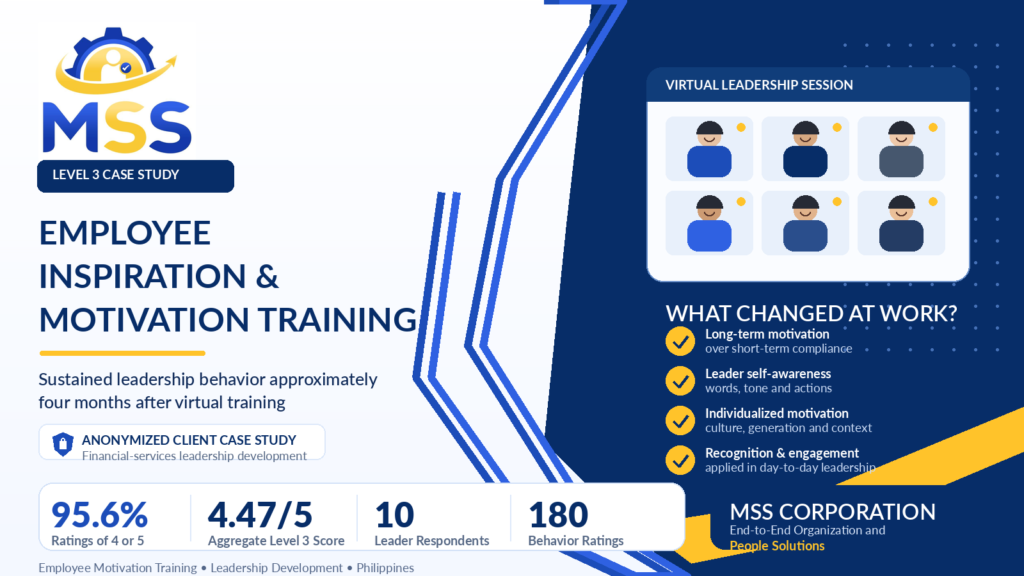
Making Strong Success (MSS) Corporation delivered two separate virtual sessions on Employee Inspiration and Motivation for Offshore Leaders for leaders of a Manila-based regional operating headquarters of an international financial services organization.
Approximately four months after the intervention, participating leaders completed a Kirkpatrick Level 3 Transfer of Learning evaluation examining whether the leadership and employee motivation practices introduced during training had become part of their actual workplace behavior.
The results provide strong evidence of sustained self-reported application.
Across 10 respondents, 18 behavior and application indicators, and 180 individual ratings, 95.6% of all ratings were either 4 or 5 on the five-point evaluation scale.
The overall average was:
4.47 out of 5.00
Even more significantly:
100% of respondents gave a rating of 4 or 5 when asked whether they had applied the key concepts from the training in their leadership role.
And:
100% gave a rating of 4 or 5 when asked whether the training had positively influenced how they motivate, recognize, and engage their teams.
For organizations looking beyond training day satisfaction toward actual behavior transfer, these findings provide an important example of what post-training evaluation can reveal.
Case Study at a Glance
| Case Study Element | Details |
|---|---|
| Client | Anonymized Manila-based regional operating headquarters of an international financial services organization |
| Training Provider | Making Strong Success (MSS) Corporation |
| Program | Employee Inspiration and Motivation for Offshore Leaders |
| Delivery Mode | Virtual |
| Delivery Structure | Two separate sessions |
| Training Period | October 2025 |
| Level 3 Evaluation Period | February 2026 |
| Time Between Training and Evaluation | Approximately 120–135 days |
| Respondents | 10 leaders |
| Leadership Span | Respondents supervised between 1 and 10 direct reports |
| Behavior/Application Indicators | 18 |
| Individual Ratings Analyzed | 180 |
| Aggregate Level 3 Score | 4.47 / 5.00 |
| Ratings of 4 or 5 | 95.6% |
| Ratings of 1 or 2 | 0% |
| Evaluation Focus | Kirkpatrick Level 3 behavior and transfer of learning |
| Privacy Approach | Client, departments, individual roles, and respondent identities withheld |
The Short Answer: Did the Employee Motivation Training Transfer to the Workplace?
Yes, based on the leaders’ self-reported behavior approximately four months after training.
Across the 180 behavior ratings:
- 51.7% received the highest rating of 5;
- 43.9% received a rating of 4;
- only 4.4% received a rating of 3;
- and no behavior rating received a 1 or 2.
Overall:
95.6% of all measured responses were rated 4 or 5.
The combined average across all 18 indicators was:
4.47 / 5.00
This matters because the evaluation was not conducted immediately after the webinar.
The leaders were assessed approximately four months later, after they had returned to the realities of managing people, workloads, different personalities, hybrid working arrangements, employee emotions, operational pressures, and day-to-day leadership challenges.
Why Employee Motivation Training Must Go Beyond Motivation Theory
One of the biggest misconceptions about employee motivation is that leaders can motivate people simply by:
- giving incentives;
- praising employees;
- holding motivational talks;
- offering rewards;
- or asking people to “stay positive.”
Sustainable employee motivation is more complex.
Different employees may be driven by:
- purpose;
- achievement;
- recognition;
- autonomy;
- belonging;
- growth;
- financial rewards;
- family considerations;
- psychological safety;
- flexibility;
- meaningful relationships;
- career opportunities;
- or a combination of these factors.
Effective leaders therefore need to understand not only what motivates employees, but also how their own leadership behavior can either strengthen or weaken motivation.
The intervention was designed around that principle.
Rather than teaching leaders to “motivate everyone the same way,” the program encouraged them to become more intentional about understanding employees and adapting their leadership approach accordingly.
What Leadership Behaviors Were Evaluated?
The Kirkpatrick Level 3 survey examined whether participating leaders were applying behaviors across several interconnected areas.
These included:
Motivation Mindset and Leadership Behavior
Leaders assessed whether they were:
- differentiating between intrinsic and extrinsic motivation;
- focusing on long-term motivation rather than short-term compliance;
- connecting daily work with purpose and meaning;
- creating psychological safety and trust;
- inspiring instead of pressuring employees; and
- becoming more conscious of how their words, tone, and actions affect motivation.
Recognition and Rewards
The evaluation examined whether leaders were:
- providing timely and specific recognition;
- balancing monetary and non-monetary rewards;
- avoiding generic or insincere praise; and
- making recognition an ongoing leadership habit.
Cultural, Generational and Personal Motivators
Leaders assessed whether they were:
- considering Filipino cultural motivators;
- adapting approaches across generations; and
- becoming more sensitive to employees’ personal, family, and emotional circumstances.
Sustaining Motivation in a High-Pressure Environment
The evaluation also examined whether leaders were:
- addressing burnout, monotony, or disengagement;
- using recognition, flexibility, or task variety;
- and recognizing small wins and micro-successes to sustain morale.
Overall Transfer of Learning
Finally, participants assessed whether:
- they had applied the key concepts of the training in their leadership role; and
- the training had positively influenced how they motivate, recognize, and engage their teams.
Overall Level 3 Result: 95.6% High Application Ratings
The 10 leaders responded to 18 behavior and transfer indicators.
This generated:
10 respondents × 18 indicators = 180 individual ratings
Of those:
- 93 ratings or 51.7% were 5;
- 79 ratings or 43.9% were 4;
- 8 ratings or 4.4% were 3;
- 0 ratings were 1 or 2.
Therefore:
172 of 180 ratings—or 95.6%—were either 4 or 5.
The aggregate result was:
4.47 / 5.00
The absence of ratings below 3 is also noteworthy.
While the study is based on self-assessment and should therefore not be interpreted as independent proof of causation, the results indicate consistently high reported workplace application several months after the intervention.
Result 1: Leaders Shifted Toward Long-Term Motivation
One of the highest-rated behaviors was:
“I focus more on building long-term motivation, not just short-term compliance.”
Result:
4.70 / 5.00
And:
100% of respondents rated themselves 4 or 5.
This distinction is important.
Compliance asks:
“How do I get an employee to do this now?”
Motivational leadership asks:
“What conditions will help this employee remain committed, capable, engaged, and willing to contribute over time?”
The results suggest that participating leaders were increasingly thinking beyond immediate obedience toward more sustainable sources of employee motivation.
Result 2: Leaders Became More Conscious of Their Own Impact on Motivation
Another highest-rated behavior involved awareness of how a leader’s behavior affects employees:
“I am more aware of how my words, tone, and actions affect team motivation.”
Average:
4.70 / 5.00
Positive ratings of 4 or 5:
100%
This is an important behavioral outcome because leaders sometimes look for the cause of disengagement entirely within the employee.
But leadership behavior itself can influence:
- confidence;
- psychological safety;
- willingness to speak;
- trust;
- morale;
- perceived fairness;
- and employee willingness to go beyond minimum requirements.
Greater self-awareness therefore becomes part of employee motivation.
Result 3: Leaders Reported Inspiring Rather Than Pressuring Employees
Participants assessed whether they were making a stronger effort to inspire rather than pressure their teams to perform.
Average:
4.60 / 5.00
Ratings of 4 or 5:
100%
The behavioral shift being encouraged was not toward lowering performance expectations.
It was toward creating performance through:
clarity + trust + purpose + recognition + appropriate support
rather than depending excessively on:
fear + pressure + authority + compliance
This is particularly relevant for leaders managing employees in demanding operational environments where sustained pressure can eventually contribute to disengagement and burnout.
Result 4: Filipino Cultural Motivators Were Being Applied
Participants also evaluated whether they considered Filipino cultural motivators when leading their teams.
Examples discussed within the evaluation included concepts such as:
- interpersonal harmony;
- cooperation;
- community;
- family-centered considerations; and
- collective support.
Average:
4.60 / 5.00
Ratings of 4 or 5:
100%
This reinforces an important principle in leadership development:
Motivation does not occur in a cultural vacuum.
A leadership approach that works in one environment may require adaptation in another.
For Philippine workplaces, understanding how relationships, family, belonging, respect, cooperation, and social dynamics influence employees can help leaders apply motivation strategies more intelligently.
Result 5: Leaders Adapted Their Approach Across Generations
Participants evaluated whether they adjusted their motivation approach based on generational differences among team members.
Result:
4.50 / 5.00
And:
100% rated themselves 4 or 5.
This suggests that leaders were moving away from a one-size-fits-all approach.
Employees at different career stages and with different life priorities may respond differently to:
- recognition;
- autonomy;
- advancement;
- stability;
- feedback;
- flexibility;
- development opportunities;
- compensation;
- or purpose.
Effective motivation therefore requires leaders to understand the individual—not simply apply the same motivational technique to everyone.
Result 6: Leaders Became More Sensitive to Personal and Emotional Factors
Participants were also asked whether they had become more sensitive to personal, family, and emotional factors that affect employee motivation.
Average:
4.50 / 5.00
Ratings of 4 or 5:
100%
The qualitative feedback supported this finding.
Some leaders reported placing greater emphasis on:
- empathy;
- checking in with team members;
- understanding individual circumstances;
- encouraging employees to take appropriate breaks;
- and creating opportunities for employees to raise concerns.
This does not mean leaders should remove performance accountability.
It means recognizing that employees are people before they are productivity numbers.
Result 7: Psychological Safety and Trust Became Part of Motivational Leadership
Participants evaluated whether they demonstrated leadership behaviors that help create psychological safety and trust.
Result:
4.40 / 5.00
Ratings of 4 or 5:
100%
Psychological safety matters because employees are more likely to:
- ask questions;
- admit uncertainty;
- raise concerns;
- share ideas;
- seek support;
- communicate mistakes;
- and contribute honestly
when they believe doing so will not automatically result in humiliation or unnecessary punishment.
Several qualitative responses referred to more open communication and greater willingness among team members to raise concerns.
These observations should be treated as participant-reported outcomes, but they are consistent with the behavioral direction encouraged during the training.
Result 8: Leaders Were Sustaining Motivation Through Small Wins, Flexibility and Recognition
Three indicators examined leaders’ efforts to sustain motivation under pressure.
The combined competency result was:
4.47 / 5.00
Approximately:
96.7% of ratings were 4 or 5.
The behaviors included:
- addressing burnout, monotony, or disengagement;
- using recognition, flexibility, or task variety;
- and proactively noticing small wins and micro-successes.
This is particularly relevant for offshore and operational environments, where repetitive tasks, service demands, workload pressure, and changing schedules may affect employee energy and engagement.
Motivation cannot always wait for major achievements.
Recognizing meaningful progress along the way can help maintain momentum.
Result 9: 100% Reported Applying the Key Concepts in Their Leadership Role
Perhaps the clearest overall Level 3 indicator was:
“Overall, I have applied the key concepts from the training in my leadership role.”
Result:
4.50 / 5.00
And:
100% of respondents gave a rating of 4 or 5.
This is especially important because the survey was conducted approximately four months after training.
The finding therefore goes beyond:
“I understood the topic during the session.”
It addresses the more important question:
“Did I actually use it while leading people?”
Result 10: 100% Said the Training Influenced How They Motivate, Recognize and Engage Their Teams
Participants were asked whether the training had positively influenced how they motivate, recognize, and engage their teams.
Average:
4.60 / 5.00
Ratings of 4 or 5:
100%
Six of the 10 leaders gave the highest possible rating.
This was one of the strongest overall indicators in the evaluation and supports the conclusion that the intervention remained relevant to leadership behavior several months after delivery.
Competency-Level Results
The 18 indicators can be grouped into five major behavior-transfer dimensions.
| Level 3 Dimension | Average | Ratings of 4 or 5 |
| Motivation Mindset and Leadership Behaviors | 4.57 / 5.00 | 98.3% |
| Recognition and Rewards | 4.25 / 5.00 | 85.0% |
| Cultural, Generational and Personal Motivators | 4.53 / 5.00 | 100% |
| Sustaining Motivation in High-Pressure Work | 4.47 / 5.00 | 96.7% |
| Overall Transfer and Influence | 4.55 / 5.00 | 100% |
These results reveal both strengths and a useful development opportunity.
The strongest transfer areas involved:
- long-term motivation;
- leadership self-awareness;
- culturally responsive motivation;
- employee empathy;
- individualized leadership;
- and overall application.
The comparatively lower area involved:
Recognition and reward practices
This does not mean recognition was ineffective.
The recognition cluster still averaged 4.25 out of 5.00.
However, compared with the other exceptionally high-scoring areas, it represents the clearest opportunity for continued reinforcement.
The Strongest Opportunity for Further Development: Recognition Systems
Two recognition-related behaviors stood out as comparatively lower than the others.
Timely and Specific Recognition
Leaders’ regular practice of timely and specific recognition averaged:
4.10 / 5.00
with:
90% rating themselves 4 or 5.
This is still a positive result.
But it suggests that knowing recognition matters does not automatically mean leaders consistently practice it.
Recognition must become a routine leadership behavior rather than something reserved for major achievements.
Balancing Monetary and Non-Monetary Rewards
The lowest-rated behavior was balancing monetary and non-monetary rewards.
Average:
4.00 / 5.00
Ratings of 4 or 5:
70%
Three respondents selected the midpoint rating.
This is a valuable finding because employee motivation is often mistakenly reduced to compensation.
Financial rewards matter, but leaders can also influence motivation through:
- meaningful recognition;
- autonomy;
- development;
- growth opportunities;
- flexibility;
- increased responsibility;
- appreciation;
- visibility;
- trust;
- purpose;
- and meaningful work.
Future reinforcement could therefore help leaders build a broader motivational toolkit rather than relying on one type of reward.
What Leadership Practices Were Participants Actually Using?
The qualitative responses provided useful context behind the quantitative results.
Because this is a public and anonymized case study, individual comments have been generalized rather than reproduced verbatim.
Recurring practices included:
Authentic Recognition
Some leaders emphasized being more sincere and deliberate in recognizing people rather than giving generic praise.
Timely Praise and Encouragement
Participants described consciously acknowledging employee effort and providing encouragement closer to the actual performance or contribution.
Intrinsic Motivation
Some leaders reported applying concepts related to understanding employees’ internal sources of motivation rather than relying entirely on external rewards.
Empathy and Personal Check-Ins
Leaders described checking on employees’ well-being, encouraging appropriate breaks, and becoming more attentive to personal and emotional circumstances.
Authentic Leadership
Being genuine in interactions also emerged as an applied leadership practice.
Relationship-Building Activities
Some leaders used informal team-building or appreciation gestures to strengthen connection and engagement.
These examples illustrate an important point:
Employee motivation is not one technique.
It is a pattern of leadership behaviors.
What Positive Changes Did Leaders Observe?
Leaders reported several perceived changes within their teams.
Recurring themes included:
Better Collaboration
Some respondents observed stronger teamwork and more collaborative engagement.
More Open Communication
Leaders reported employees becoming more willing to raise concerns, share issues, or communicate openly.
Greater Proactivity
Some participants perceived employees becoming more proactive.
Improved Engagement
Respondents described stronger interaction and participation within their teams.
Increased Productivity
At least one respondent associated the application of motivational practices with increased productivity.
These findings are encouraging, but they must be interpreted correctly.
They are leaders’ observations, not independently verified organizational performance measures.
Accordingly, they should be treated as supporting qualitative evidence rather than definitive Kirkpatrick Level 4 business results.
What Challenges Did Leaders Encounter?
Behavior transfer does not happen without friction.
Participants identified several practical challenges.
Hybrid and Office Scheduling
Different work schedules sometimes made it difficult to have the entire team physically together at the same time.
Consistency
Some leaders acknowledged that consistently applying new leadership practices remained difficult.
This is common in behavior change.
Knowing a good leadership practice is easier than turning it into a habit during busy periods.
Emotional Self-Regulation
Leaders also identified their own emotions as an implementation challenge.
This reinforces an important point:
Leaders cannot manage employee motivation effectively without also managing themselves.
Individual Differences
Some respondents found it challenging to develop different motivational approaches for different team members.
That challenge is also evidence of the complexity of motivation.
Personalization requires more leadership effort than applying the same technique to everybody.
What Reinforcement Would Help Sustain the Behavior?
Participants identified several forms of additional support.
These included:
- consistent reinforcement from immediate managers;
- personal reminders to practice motivational behaviors;
- more learning interventions;
- more real-life leadership scenarios;
- and continued opportunities to strengthen practical application.
These responses suggest that the next step is not necessarily to repeat the entire program.
Instead, organizations can reinforce transfer through:
Manager Reinforcement
Senior leaders should model and encourage the same motivational behaviors expected from frontline and middle leaders.
Habit Prompts
Simple leadership reminders or recurring prompts can help convert intentions into routines.
Coaching
Short coaching conversations can help leaders work through difficult real-world employee situations.
Scenario-Based Refreshers
Realistic workplace cases can deepen leaders’ ability to adapt motivation principles to different personalities and circumstances.
Recognition Systems
Organizational processes can help make recognition more consistent rather than depending entirely on individual manager memory.
What Does This Case Study Demonstrate About Leadership Training?
It demonstrates why corporate training should not end when the virtual session closes.
Traditional evaluation often asks:
Did participants like the trainer?
Was the session engaging?
Was the content useful?
Those questions matter—but they are not enough.
Kirkpatrick Level 3 asks something harder:
What are participants actually doing differently afterward?
Approximately four months after this Employee Inspiration and Motivation intervention:
- 10 leaders participated in the evaluation;
- 18 behavior and application indicators were measured;
- 180 individual ratings were analyzed;
- 95.6% of those ratings were 4 or 5;
- the aggregate score was 4.47 out of 5.00;
- 100% reported applying the key concepts in their leadership roles at a high level; and
- 100% reported that the training had positively influenced how they motivate, recognize, and engage their teams at a high level.
That provides more meaningful evidence of training effectiveness than a reaction form completed immediately after a webinar.
What These Results Do Not Prove
A credible case study should be equally clear about the limitations of its evidence.
This Level 3 assessment primarily used leader self-reporting.
The dataset used for this public case study did not include:
- matched employee engagement scores before and after training;
- independent observations of each leader;
- ratings from employees reporting to each leader;
- pre-training and post-training productivity comparisons;
- absenteeism or retention analysis;
- control groups;
- verified financial outcomes;
- or return-on-investment calculations.
Therefore, the evidence supports conclusions about:
Reported workplace behavior transfer and sustained leadership application
It does not establish that the training alone caused measurable company-level improvements in:
- productivity;
- employee retention;
- profitability;
- engagement scores;
- or other organizational performance indicators.
Those outcomes would require additional Level 4 or business-performance evidence.
Being transparent about this distinction makes training evaluation more—not less—credible.
Why This Matters When Choosing Training Providers in the Philippines
Organizations searching for training providers in the Philippines should not evaluate suppliers only on:
- the trainer’s popularity;
- presentation style;
- client logos;
- course catalog;
- price;
- or participant satisfaction.
Ask the provider:
What behaviors should change after this training?
How will those behaviors be applied in the workplace?
How can managers reinforce them?
When should transfer of learning be evaluated?
What evidence will tell us whether participants are actually using the learning?
These questions also matter when evaluating training and consultancy companies in the Philippines, training firms in the Philippines, corporate training companies in the Philippines, or organizations offering leadership-development interventions.
MSS Corporation believes that training should increasingly move through the complete learning-performance chain:
Learning → Application → Behavior → Performance
Why MSS Corporation Measures Transfer of Learning
Making Strong Success (MSS) Corporation approaches corporate training as more than a scheduled event.
An effective learning intervention should answer four questions:
1. What should participants understand?
Training must first provide relevant knowledge and insight.
2. What should participants be able to do?
Learning must translate into practical capability.
3. What should participants actually do differently back at work?
This is where behavior transfer becomes critical.
4. What should the organization reinforce afterward?
Managers, systems, culture, and workplace conditions influence whether new behaviors survive.
That is why post-training evaluation matters.
Our goal is not simply to deliver a successful learning session.
It is to help organizations turn learning into useful workplace behavior.
Looking for Employee Motivation or Leadership Training in the Philippines?
Organizations looking for Employee Motivation Training in the Philippines, Leadership Training in the Philippines, Management Training in the Philippines, or customized corporate learning interventions can engage MSS Corporation to design programs around their actual organizational environment.
Programs may be customized according to:
- leadership levels;
- employee demographics;
- organizational culture;
- workforce challenges;
- engagement concerns;
- performance expectations;
- hybrid or remote working arrangements;
- management practices;
- and desired workplace behaviors.
The objective is not to deliver generic motivation theory.
It is to help leaders develop practical behaviors that enable employees to feel:
understood, recognized, trusted, challenged, supported, connected, and motivated to contribute.
Frequently Asked Questions
What is Kirkpatrick Level 3 training evaluation?
Kirkpatrick Level 3 examines whether participants apply the learning and demonstrate the intended behaviors after returning to their working environment.
It moves training evaluation beyond what participants learned toward what they actually do.
Did the Employee Inspiration and Motivation Training change leadership behavior?
Based on the participant self-assessment, the evidence indicates strong reported transfer.
Across 180 behavior and application ratings collected approximately four months after training, 95.6% received a rating of 4 or 5, with an aggregate score of 4.47 out of 5.00.
How many leaders participated in the Level 3 evaluation?
The evaluation contained 10 completed leader responses.
How long after training was the evaluation conducted?
The responses were collected approximately 120 to 135 days after the two virtual training sessions, or roughly four months after the intervention.
What was the overall Level 3 score?
The average across all 18 behavior and transfer indicators was:
4.47 out of 5.00.
Did participants continue applying the training?
Yes.
100% of respondents gave themselves a rating of 4 or 5 when assessing whether they had applied the key concepts from the training in their leadership role.
What was the strongest behavior-transfer result?
Two behaviors achieved the highest average of 4.70 out of 5.00:
- focusing on long-term motivation rather than short-term compliance; and
- becoming more aware of how one’s words, tone, and actions affect team motivation.
Both received ratings of 4 or 5 from 100% of respondents.
What was the primary opportunity for additional development?
Recognition and reward practices represented the clearest reinforcement opportunity.
The overall Recognition and Rewards dimension averaged 4.25 out of 5.00, lower than the other competency areas, while balancing monetary and non-monetary rewards averaged 4.00 out of 5.00.
What employee motivation practices were leaders applying?
Reported practices included authentic recognition, timely praise and encouragement, empathy, employee check-ins, intrinsic motivation, authentic leadership, and relationship-building activities.
What challenges did leaders experience when applying the learning?
Recurring challenges included maintaining consistency, regulating personal emotions, adapting motivational approaches to different employees, and working around hybrid or office schedules.
What should companies look for when choosing training providers in the Philippines?
Organizations should consider:
- customization;
- facilitator expertise;
- relevance to actual workplace challenges;
- opportunities for practical application;
- post-training reinforcement;
- transfer-of-learning evaluation; and
- evidence that intended behaviors are actually being applied after training.
Does MSS Corporation customize employee motivation and leadership training?
Yes.
MSS Corporation designs customized corporate learning interventions around the client’s organizational context, participant profile, workforce challenges, leadership requirements, and desired workplace behaviors.
Methodology and Evidence-Integrity Note
This public case study is based on an anonymized Kirkpatrick Level 3 Transfer of Learning evaluation involving 10 leaders.
The assessment contained 18 quantitative behavior and application indicators, generating 180 individual ratings, together with qualitative questions concerning:
- leadership practices applied;
- perceived changes in teams;
- implementation challenges; and
- reinforcement needs.
The Level 3 responses were collected in February 2026, approximately 120–135 days after the two October 2025 virtual sessions.
For this analysis:
- ratings of 4 and 5 were treated as high application ratings;
- all quantitative responses were included in the aggregate calculations;
- qualitative comments were analyzed for recurring themes;
- perceived employee or team outcomes were treated as participant observations rather than independently validated Level 4 results; and
- no personally identifying respondent information is reproduced.
To protect confidentiality and reduce re-identification risk, the public case study does not disclose:
- the client organization’s name;
- specific departments or teams;
- individual job titles;
- participant identities;
- or verbatim comments that may unnecessarily identify respondents.
The purpose is to demonstrate the evidence of training transfer while maintaining appropriate client and participant confidentiality.
About Making Strong Success (MSS) Corporation
Making Strong Success (MSS) Corporation is an organization and people solutions company providing corporate training, consulting, coaching, facilitation, speaking, organizational development, and related professional solutions in the Philippines.
Our learning interventions are designed not simply around what participants should know during a program, but around what they should be able to apply afterward.
For organizations comparing training and consultancy companies in the Philippines or looking for a corporate training provider in the Philippines, our aim is to provide customized interventions grounded in actual organizational needs, practical application, and measurable development.
We believe effective corporate learning should ultimately move people from:
KNOWING → DOING → SUSTAINING → PERFORMING
Request a Customized Leadership or Employee Motivation Training Program
If your organization is looking for a training provider in the Philippines that can design customized leadership, employee motivation, engagement, communication, management, or people-development interventions, talk to Making Strong Success (MSS) Corporation.
Let us design a learning intervention around the behaviors your leaders and employees actually need to demonstrate—not simply the topics they need to hear.