Telesales Training Case Study: Kirkpatrick Level 3 Behavior Transfer in a Major Philippine Financial Institution
How a Two-Batch, Three-Day Effective Telesales Training Program Translated Into Sustained Workplace Application Approximately Three Months Later
When organizations compare training and consultancy companies in the Philippines, one of the most important questions should not be:
“Was the training enjoyable?”
It should be:
“Are employees still using what they learned when they return to work?”
That question becomes particularly important in sales training, where knowing a technique is different from consistently using it while dealing with real customers, objections, rejection, performance expectations, and the pressure of an actual sales conversation.
Making Strong Success (MSS) Corporation conducted two batches of a three-day Effective Telesales Training Program for sales employees of a major Philippine financial institution.
Approximately 12 to 13 weeks after the training, a Kirkpatrick Level 3 Transfer of Learning assessment was conducted to examine whether participants were applying the targeted telesales behaviors in their actual work.
The results provide substantial evidence of reported workplace application.
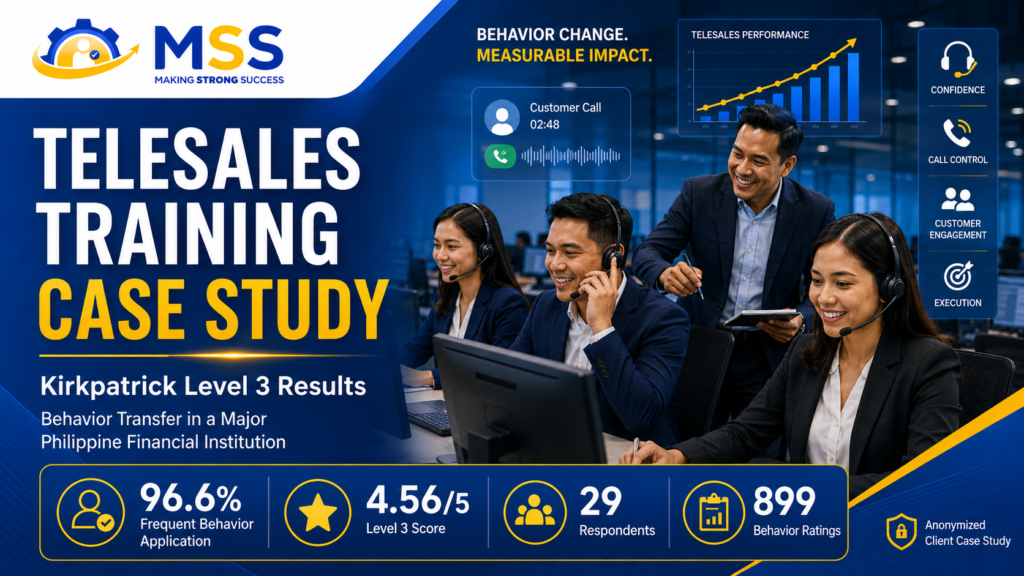
Across 29 respondents and 31 behavior indicators—representing 899 individual behavior ratings—96.6% were rated either “Often” or “Consistently.”
The aggregate behavior application rating was 4.56 out of 5.00.
And when respondents were asked to rate their overall application of the Effective Telesales Training in their role, 96.6% gave themselves a rating of 4 or 5, with an average of 4.62 out of 5.00.
For organizations searching for training providers in the Philippines, the significance is straightforward:
The training was not merely remembered. Participants reported repeatedly applying the behaviors in actual telesales conversations months after the intervention.
Case Study at a Glance
| Case Study Element | Details |
|---|---|
| Client | Anonymized major Philippine financial services institution |
| Training Provider | Making Strong Success (MSS) Corporation |
| Program | Effective Telesales Training |
| Delivery Structure | Two separate batches |
| Training Duration | Three full training days per batch |
| Participants Evaluated | Sales personnel engaged primarily in inbound and outbound telesales |
| Level 3 Respondents | 29 |
| Evaluation Timing | Approximately 12–13 weeks after training |
| Evaluation Framework | Kirkpatrick Level 3 — Behavior / Transfer of Learning |
| Behavior Indicators | 31 observable or self-reported workplace telesales behaviors |
| Individual Behavior Ratings Analyzed | 899 |
| Aggregate Behavior Score | 4.56 / 5.00 |
| Behavior Ratings of “Often” or “Consistently” | 96.6% |
| Overall Application Rating | 4.62 / 5.00 |
| Respondents Rating Overall Application 4 or 5 | 96.6% |
| Privacy Approach | Aggregated and anonymized public reporting |
The Short Answer: Did the Telesales Training Transfer to the Workplace?
The respondents overwhelmingly reported that it did.
Approximately three months after training:
- 96.6% of all 899 behavior ratings indicated that the targeted telesales behavior was being demonstrated Often or Consistently.
- 59.4% of all behavior ratings were at the highest level: Consistently.
- The aggregate behavior transfer score was 4.56 out of 5.00.
- 100% of respondents reported that they were more confident handling telesales calls either Often or Consistently.
- 96.6% reported consistently applying the telesales framework across calls at least Often.
- 96.6% reported feeling more in control of sales conversations than before training.
- 96.6% reported being more intentional and strategic in their calling approach.
- 96.6% rated their overall application of the program at 4 or 5 out of 5.
These findings are important because Kirkpatrick Level 3 focuses on whether learning transfers into behavior in the participant’s working environment—not simply whether the participant understood or liked the training.
Why Telesales Training Often Fails at the Point of Application
Telesales employees may understand sales concepts during training yet still return to old habits once they begin handling live customer conversations.
Common examples include:
- dialing without a clear objective;
- relying too heavily on a memorized script;
- pitching before understanding the customer’s situation;
- talking more than listening;
- explaining features rather than customer value;
- losing confidence when encountering rejection;
- becoming defensive when objections arise;
- failing to recognize buying signals;
- hesitating to ask for the sale;
- rushing calls;
- sounding overly aggressive;
- and ending conversations without clearly confirming next steps.
The business challenge is therefore not merely:
“Can employees explain the telesales process?”
The stronger question is:
“Do they actually behave differently when the customer is on the line?”
That is why this evaluation focused on behavioral application.
What Behaviors Were Evaluated?
The Level 3 assessment examined the complete flow of a professional telesales conversation.
The 31 evaluated behaviors covered eight major competency areas:
- Call preparation and professional mindset
- Opening, rapport and call control
- Discovery and needs diagnosis
- Value communication and consultative selling
- Objection handling
- Closing and next-step discipline
- Professional communication, call management and compliance with telesales standards
- Post-training confidence and strategic application
This is important because an effective sales conversation is not created by one isolated closing technique.
Performance depends on the entire behavioral chain.
Preparation → Opening → Rapport → Discovery → Value → Objection Handling → Closing → Follow-Through
Weakness in one part of that chain can reduce the effectiveness of everything that follows.
Overall Kirkpatrick Level 3 Result: 96.6% Positive Behavior Application
The 29 respondents answered 31 behavior transfer questions.
This generated:
29 respondents × 31 behaviors = 899 behavior ratings
Of those 899 ratings:
- 534 or 59.4% were rated 5 — Consistently
- 334 or 37.2% were rated 4 — Often
- 30 or 3.3% were rated 3 — Sometimes
- only 1 response or 0.1% was rated at the lowest application level
Therefore:
96.6% of all measured behavior ratings fell within “Often” or “Consistently.”
The overall average was:
4.56 / 5.00
For a behavioral evaluation conducted roughly three months after training, the results indicate substantial reported retention and workplace application of the targeted telesales behaviors.
Result 1: Stronger Call Preparation and Professional Mindset
The first competency cluster examined whether participants approached telesales intentionally rather than merely dialing and reacting.
Across the four behaviors in this area:
98.3% of ratings were “Often” or “Consistently.”
Average:
4.55 / 5.00
Most notably:
100% reported approaching telesales calls with a clear objective and call plan at least Often.
Participants also reported strong application of:
- mentally preparing before calls;
- maintaining confidence and composure despite call outcomes; and
- treating calls as professional sales conversations rather than merely delivering scripts.
This distinction matters.
Professional telesales begins before the customer answers the phone.
When sellers become more deliberate about what they are trying to accomplish, they are better positioned to manage the conversation strategically.
Result 2: Strong Application of Rapport, Openings and Call Control
Participants were evaluated on their ability to:
- establish rapport;
- open conversations effectively;
- control the direction of the call professionally; and
- avoid sounding robotic or excessively scripted.
The aggregate score for this competency area was:
4.53 / 5.00
Approximately 93.1% of the ratings in this category were either Often or Consistently.
One particularly strong behavior was:
96.6% reported avoiding robotic or overly scripted delivery at least Often.
This finding was reinforced by the open-ended feedback.
Respondents repeatedly mentioned:
- rapport building;
- professional wording;
- tone of voice;
- more natural conversation;
- confident openings;
- and avoiding a pushy approach.
The intended behavioral shift was therefore not simply:
“Memorize a better script.”
It was:
“Learn how to conduct a better sales conversation.”
Result 3: Discovery Became a Core Part of the Sales Conversation
One of the major risks in telesales is prematurely presenting a product before understanding the customer.
The Level 3 assessment therefore examined whether participants:
- asked purposeful questions;
- listened actively;
- avoided premature pitching; and
- tailored their offer based on the customer’s responses.
The aggregate result was:
4.53 / 5.00
And 96.6% of behavior ratings in this competency cluster were Often or Consistently.
Open-ended responses reinforced the quantitative findings.
Participants specifically referred to behaviors such as:
- understanding the customer’s situation first;
- asking questions to understand the customer;
- active listening;
- empathy;
- using open-ended questions;
- and listening before moving into the pitch.
This indicates movement toward a more consultative telesales approach rather than a product-first approach.
Result 4: Value Communication Was One of the Strongest Competency Areas
The training emphasized communicating customer value rather than simply enumerating features.
Across the value-communication behaviors, the average was:
4.60 / 5.00
And:
98.3% of ratings were Often or Consistently.
Most significantly:
100% reported clearly communicating the value of the product or service—not merely its features—at least Often.
Participants also demonstrated strong reported application in:
- connecting benefits to customer needs or pain points;
- explaining value confidently; and
- avoiding excessive pressure or overselling.
One participant specifically described becoming more deliberate about communicating the benefit of the product to the client.
Another referred to being less pushy while remaining professional.
That distinction is crucial in modern sales conversations:
Persuasion is not pressure.
The objective is to help the customer understand relevance and value.
Result 5: Objection Handling Became a Major Behavioral Strength
Objections are one of the defining moments of a telesales conversation.
Respondents were evaluated on whether they:
- remained calm;
- acknowledged objections;
- used structured objection-handling techniques; and
- avoided becoming defensive or argumentative.
The aggregate competency score was:
4.59 / 5.00
Approximately:
96.6% of objection-handling ratings were Often or Consistently.
The strongest individual behavior in the entire survey was:
100% reported handling objections calmly and professionally at least Often.
The average for that behavior was:
4.72 / 5.00
This was the highest-rated individual competency measured.
That does not mean rejection disappeared.
In fact, rejection remained one of the most frequently mentioned challenges in the qualitative feedback.
The more important behavioral outcome is that participants reported becoming better equipped to manage rejection without allowing it to derail the professionalism of the conversation.
Result 6: Closing and Next-Step Discipline Remained Strong
Participants were also evaluated on whether they could:
- recognize buying signals;
- confidently ask for the sale or next step;
- select an appropriate closing technique; and
- clearly confirm agreements, follow-ups or next actions.
The combined score was:
4.55 / 5.00
And approximately:
97.4% of ratings were Often or Consistently.
Two particularly important findings emerged:
100% reported using appropriate closing techniques based on the situation at least Often.
And:
100% reported clearly confirming agreements, next steps or follow-ups at least Often.
Asking for commitment remains an area where continued coaching can still create additional value.
While the behavior remained strong overall, confidently asking for the sale or next step was one of the relatively lower-scoring individual items compared with the exceptionally high scores elsewhere.
That gives management a clear reinforcement opportunity:
Strong conversations still need confident conversion into an agreed next action.
Result 7: Professional Communication and Call Management Remained High
The assessment also examined:
- tone;
- pace;
- clarity;
- time management; and
- consistency with telesales standards and protocols.
The average result was:
4.53 / 5.00
Approximately:
94.3% of ratings were Often or Consistently.
Qualitative responses repeatedly mentioned improvements in:
- tone of voice;
- calmness;
- conversational delivery;
- confidence;
- and call structure.
One respondent described becoming more confident, calm and conversational rather than pushy.
Another reported that calls had become more structured and confident, with better questioning and clearer communication.
These comments are consistent with the behavior-rating patterns found throughout the survey.
Result 8: 100% Reported Greater Confidence in Handling Telesales Calls
One of the clearest Level 3 findings concerned confidence.
Participants responded to the statement:
“Since the training, I am more confident handling telesales calls.”
The result:
100% answered Often or Consistently.
Average:
4.66 / 5.00
Of the 29 respondents:
- 19 selected Consistently
- 10 selected Often
- nobody selected Sometimes or below
Confidence also emerged repeatedly from the qualitative responses.
Participants described themselves as:
- more confident making calls;
- more confident offering products;
- more confident handling conversations;
- more confident selling;
- and calmer in their tone.
Because confidence was measured alongside specific behaviors rather than as an isolated reaction question, the finding becomes more meaningful.
Participants were not only saying:
“I feel better.”
They were simultaneously reporting changes in how they prepared, questioned, listened, communicated value, managed objections, closed and followed through.
Result 9: 96.6% Reported Consistent Use of the Telesales Framework
Participants responded to:
“I apply the telesales framework consistently across calls.”
Result:
96.6% rated themselves Often or Consistently.
Average:
4.59 / 5.00
Only one respondent selected Sometimes.
This is a particularly important transfer indicator.
Training often fails because participants selectively use a technique immediately after a workshop and then gradually return to previous habits.
Approximately three months after the intervention, respondents were still overwhelmingly reporting repeated use of the framework.
Result 10: Participants Reported Greater Control of Sales Conversations
Participants were asked whether they felt more in control of their sales conversations than before training.
Result:
96.6% answered Often or Consistently.
Average:
4.52 / 5.00
This aligns with several other behavioral findings involving:
- stronger openings;
- deliberate discovery;
- better call flow;
- calm objection handling;
- confident communication;
- and structured closing.
Being “in control” does not mean dominating the customer.
It means being able to guide the conversation professionally without allowing the call to become directionless.
Result 11: Calling Became More Intentional and Strategic
Participants were also asked:
“I am more intentional and strategic in my calling approach.”
Result:
96.6% answered Often or Consistently.
Average:
4.55 / 5.00
This is one of the most meaningful outcomes of the intervention.
Effective telesales is not simply a question of making more calls.
It is about improving the quality of what happens within each call.
Participants’ responses suggest movement from activity-driven calling toward more deliberate sales execution.
Overall Application of the Effective Telesales Training
Respondents were asked to give an overall rating for their application of the training in their current role.
The result:
4.62 / 5.00
Among 29 respondents:
- 19 or 65.5% gave themselves 5 out of 5
- 9 or 31.0% gave themselves 4 out of 5
- 1 or 3.4% gave a rating of 3 out of 5
Therefore:
96.6% rated their overall application at 4 or 5.
This closely mirrors the 96.6% positive application rate across the 899 individual behavior measurements.
The consistency between the detailed behavior questions and the overall application rating strengthens the internal coherence of the findings.
What Telesales Techniques Were Participants Actually Using?
The qualitative responses provide useful context behind the numerical results.
Recurring application themes included:
Rapport Building
Multiple respondents specifically identified rapport as a technique they continued using.
Active Listening
Participants referred to listening carefully and allowing customer responses to guide the conversation.
Empathy
Several comments highlighted understanding customer concerns and situations rather than simply pushing an offer.
Purposeful Questioning
Respondents described asking questions and using open-ended questions to understand needs before presenting solutions.
More Intentional Openings
Some respondents reported becoming more conscious of how they opened calls, established purpose and gained attention.
Clearer Value Communication
Participants described explaining benefits more specifically and connecting offers to what would help the customer.
Professional Tone and Wording
Tone, wording and professional communication emerged repeatedly.
Less Aggressive Selling
One recurring shift was avoiding excessive pressure while maintaining professional confidence.
Call Preparation
Participants also described reviewing call material or preparing before engaging customers.
Collectively, these comments reinforce an important behavioral pattern:
The training was being applied as a conversation framework—not simply as a memorized script.
What Improvements Did Participants Notice?
The most recurring improvement identified in the open-ended responses was:
Confidence
Participants repeatedly described becoming more confident in calling, selling and handling conversations.
Other reported improvements included:
- more structured calls;
- more natural conversations;
- improved questioning;
- clearer communication;
- better empathy;
- stronger customer relationships;
- calmer and more conversational tone;
- improved customer engagement;
- better call efficiency; and
- stronger understanding of customer concerns.
A small number of respondents also voluntarily mentioned outcomes such as increased customer uptake, bookings or sales.
These statements are encouraging, but they should be interpreted correctly.
They are participant-reported observations, not independently verified business-performance measures.
Accordingly, they should not be represented as definitive Kirkpatrick Level 4 organizational results or financial ROI.
What Challenges Remained Approximately Three Months After Training?
A credible case study should not publish only favorable findings.
The qualitative responses also identified continuing obstacles.
Customer Rejection
Rejection was the most visible recurring challenge.
Participants mentioned customers:
- immediately declining offers;
- repeatedly saying no;
- hesitating during closing; and
- rejecting calls or offers.
Trust and Scam Concerns
Some respondents reported that customers had become increasingly suspicious of unfamiliar calls, with some assuming that calls might be fraudulent.
This creates a challenge that telesales technique alone cannot completely eliminate.
Reaching Customers
Respondents also mentioned:
- unanswered calls;
- incorrect contact information;
- poor timing;
- and limited opportunities to engage customers.
Product Knowledge
At least some respondents identified deeper product familiarity as an area that could improve persuasion and confidence.
Handling Different Customer Personalities
One response highlighted the difficulty of adapting quickly to different types of customers without visual cues.
Closing Consistency
Maintaining closing discipline when customers became hesitant was also identified as a continuing development opportunity.
These findings are useful because they help identify where reinforcement should go next.
What Additional Support Did Participants Want?
Respondents’ recommendations largely pointed toward reinforcement rather than a complete redesign of the original training.
Common suggestions included:
- refresher training;
- additional telesales development;
- advanced coaching;
- regular feedback sessions;
- product familiarization;
- coaching on rejection;
- handling difficult customers;
- further development of confidence;
- and access to ongoing learning resources.
One respondent specifically identified support from supervisors and colleagues.
Another indicated that the training already provided sufficient learning.
These responses reinforce a basic principle of behavior transfer:
A workshop can initiate behavior change, but reinforcement helps turn new behaviors into habits.
What Should Management Reinforce Next?
Based on the Level 3 findings, the strongest next-stage priorities would be:
1. Preserve What Is Already Working
The organization should continue reinforcing:
- calm objection handling;
- consultative value communication;
- professional tone;
- discovery;
- rapport;
- structured sales conversations; and
- clear next-step confirmation.
2. Strengthen the Relatively Lower Behaviors
Even though scores remained high, management could place additional attention on:
- confidently asking for commitment;
- early rapport building;
- call-time management;
- maintaining call control;
- and consistently avoiding premature pitching.
3. Provide Continuous Coaching
Short coaching conversations based on actual telesales experiences can help participants translate principles into responses for increasingly difficult situations.
4. Strengthen Product Mastery
The stronger the salesperson’s product understanding, the easier it becomes to adapt value propositions naturally rather than relying heavily on scripts.
5. Coach Around Rejection and Customer Trust
Given increased customer resistance to unfamiliar calls, teams may benefit from further development in:
- trust building;
- credibility establishment;
- rejection recovery;
- difficult-customer conversations; and
- re-engagement.
What Does This Case Study Demonstrate About Training Effectiveness?
It demonstrates why corporate training evaluation should extend beyond the seminar room.
A training provider can receive excellent participant feedback immediately after a program and still fail to create meaningful workplace application.
Level 3 asks a harder question:
What are people doing differently back at work?
In this case, approximately three months after two separate three-day telesales programs:
- 29 respondents were evaluated;
- 31 behaviors were measured;
- 899 individual behavior ratings were generated;
- 96.6% of those ratings were Often or Consistently;
- the aggregate behavioral score was 4.56/5.00;
- and the overall program-application score was 4.62/5.00.
Those findings provide a substantially richer view of training effectiveness than a standard end-of-program satisfaction sheet.
What These Results Do NOT Prove
Evidence-based case studies become more credible when their limitations are disclosed.
This evaluation relied primarily on participant self-reporting.
It did not include, within the dataset used for this public case study:
- independently scored call recordings;
- direct behavioral observation;
- supervisor ratings matched to each respondent;
- pre-training versus post-training conversion-rate analysis;
- customer satisfaction comparisons;
- control groups;
- verified revenue attribution;
- or financial ROI analysis.
Therefore, this case study supports conclusions regarding:
Reported Kirkpatrick Level 3 workplace behavior transfer
It should not be presented as definitive evidence that training alone caused:
- higher sales revenue;
- improved conversion rates;
- increased bookings;
- improved customer satisfaction;
- or other enterprise-level business results.
Those would require additional Level 4 or business-performance evidence.
This distinction is intentional.
Credible training evaluation means reporting what the evidence demonstrates without exaggerating what it does not demonstrate.
Why This Matters When Choosing Training Providers in the Philippines
Organizations evaluating training providers in the Philippines should consider more than:
- trainer popularity;
- presentation style;
- participant entertainment;
- impressive client logos;
- or low training fees.
Ask:
What behavior should change after the training?
How will participants apply it?
How will transfer be measured?
When will the organization evaluate application?
What will managers reinforce afterward?
These questions also matter when comparing training and consultancy companies in the Philippines, training and consultancy firms in the Philippines, or consultancy companies in the Philippines that provide people-development interventions.
And even when an organization is choosing among public seminar organizers in the Philippines, training-day satisfaction should not be the only standard of quality.
A serious learning provider should be thinking beyond attendance toward:
Learning → Application → Behavior → Performance
The MSS Corporation Approach
Making Strong Success (MSS) Corporation approaches corporate learning as a workplace-performance intervention rather than merely an event.
That means asking:
What should participants know?
What should participants be able to do?
What should they actually do differently back at work?
How can management reinforce those behaviors?
How will we determine whether transfer happened?
The objective is not merely to deliver information.
It is to create a practical learning experience that participants can translate into real workplace behavior.
This Effective Telesales Training engagement provides one example of that approach.
Looking for Telesales Training in the Philippines?
Organizations looking for Telesales Training in the Philippines, Sales Training in the Philippines, or a customized corporate sales-development intervention can engage MSS Corporation to design the program around their:
- products and services;
- customer segments;
- actual sales process;
- selling channels;
- common objections;
- telesales environment;
- customer-experience standards;
- performance expectations; and
- desired workplace behaviors.
Programs can be designed not simply around what employees should learn during training, but around what they should be able to apply after training.
Frequently Asked Questions
What is Kirkpatrick Level 3 training evaluation?
Kirkpatrick Level 3 focuses on behavior—whether participants apply what they learned once they return to their working environment.
Did participants apply the Effective Telesales Training after the program?
Yes, based on the participant self-assessment.
Across 899 individual behavior ratings collected from 29 respondents, 96.6% were rated Often or Consistently approximately 12 to 13 weeks after training.
How many employees participated in the Level 3 survey?
The Level 3 dataset contained 29 completed responses.
How long after training was the Level 3 evaluation conducted?
Depending on the batch attended, the survey was completed approximately 12 to 13 weeks after training.
What was the overall Level 3 behavior score?
Across the 31 evaluated behaviors, the aggregate rating was:
4.56 out of 5.00.
How many respondents reported increased telesales confidence?
100% of respondents indicated that they were more confident handling telesales calls either Often or Consistently.
Did employees continue applying the telesales framework?
96.6% reported applying the telesales framework across calls either Often or Consistently.
Which behavior received the strongest result?
Handling objections calmly and professionally achieved an average rating of approximately 4.72 out of 5.00, with 100% of respondents rating the behavior Often or Consistently.
What telesales techniques did participants continue using?
Recurring themes included rapport building, active listening, empathy, purposeful questioning, better openings, professional tone, consultative value communication, call preparation and less aggressive selling.
What challenges remained after training?
Recurring challenges included customer rejection, customer distrust of unfamiliar calls, unanswered calls, timing, product knowledge, adapting to different customer personalities and maintaining closing confidence.
Does this prove that sales increased because of the training?
No.
The available Level 3 data measures reported behavioral application. Although some respondents voluntarily mentioned improved bookings, customer uptake or sales, these statements were not independently verified and should not be treated as proof of Level 4 business results or training ROI.
What should companies look for when choosing training and consultancy companies in the Philippines?
Companies should evaluate relevance, customization, facilitator competence, practical application, post-training reinforcement and evidence that participants actually use what they learned.
Does MSS Corporation customize telesales training?
Yes. MSS Corporation can customize corporate sales and telesales interventions around an organization’s actual customers, products, selling situations, common objections, desired competencies and expected workplace behaviors.
Methodology and Evidence Note
This public case study is based on an anonymized post-training Kirkpatrick Level 3 Transfer of Learning survey involving 29 respondents.
The evaluation measured 31 workplace telesales behaviors using a five-point application scale.
For this analysis:
- ratings of 4 — Often and 5 — Consistently were classified as high-frequency application;
- aggregate scores were calculated across the applicable responses;
- qualitative comments were analyzed for recurring themes; and
- participant comments referring to sales or customer outcomes were treated as self-reported observations rather than independently verified business results.
The survey was conducted approximately 84 to 93 days after training, depending on the respondent’s batch.
For public reporting, the client organization, individual respondents, specific organizational units, personal identifiers and other potentially identifying or confidential information have been withheld.
The purpose of this case study is to transparently communicate evidence of training transfer while protecting participant privacy and client confidentiality.
About Making Strong Success (MSS) Corporation
Making Strong Success (MSS) Corporation provides corporate training, consulting, coaching, facilitation, speaking and organizational-development solutions in the Philippines.
MSS Corporation designs customized interventions intended to help organizations move beyond learning-event completion toward practical workplace application and stronger employee capability.
Our focus is not simply:
“Was the training conducted?”
It is:
“Did the learning become useful behavior?”
Request a Customized Corporate Training Program
If your organization is currently comparing training providers in the Philippines or training and consultancy companies in the Philippines, MSS Corporation can help design an intervention around your actual business needs rather than simply providing a generic seminar.
Request a customized corporate training proposal from Making Strong Success (MSS) Corporation.