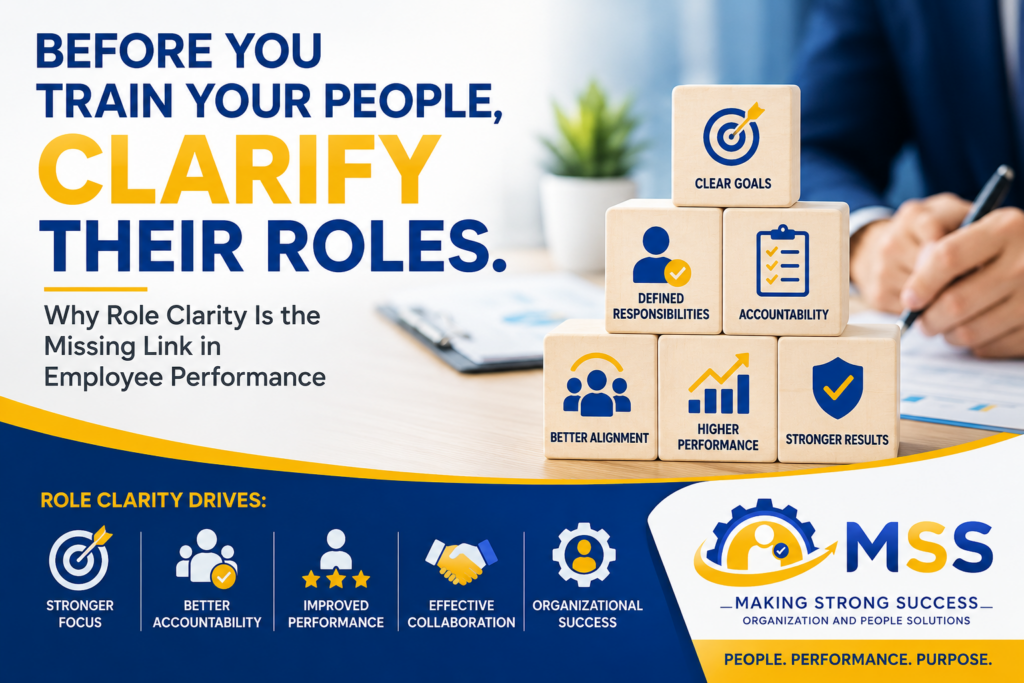
Role Clarity before Employee Training Philippines Many Philippine companies invest heavily in training every year. Employees attend leadership workshops, communication seminars, customer service programs, team building activities, coaching sessions, and motivational talks.
Yet after all the learning interventions, one problem often remains:
People still do not perform the way the organization expects them to.
When this happens, leaders usually ask, “Do we need more training?”
But sometimes, the better question is:
Do our people clearly understand their roles, responsibilities, accountabilities, and expected results?
For business owners, executives, HR managers, Learning and Development managers, and procurement officers looking for a reliable training and consultancy company in the Philippines, this is an important distinction. Because before training can truly work, employees must first know what they are being developed for.
The Problem: Training Cannot Fix Role Confusion
Training is powerful when the issue is a lack of knowledge, skill, or behavior. But training becomes less effective when employees are unclear about what their job actually requires.
Role confusion happens when employees are unsure about:
- what they are responsible for;
- which decisions they can make;
- who they report to;
- what results they are expected to produce;
- how their work connects to company goals;
- where their accountability begins and ends.
When these things are unclear, even hardworking employees may underperform—not because they lack effort, but because they lack direction.
A sales employee may think the priority is relationship-building, while management expects aggressive conversion. A supervisor may believe the job is task monitoring, while the company expects coaching and performance management. A department head may focus on daily operations while top management expects strategic execution.
In these cases, another training program may help—but it will not fully solve the problem unless role clarity is addressed first.
Why Role Clarity Matters to Organizational Performance
Role clarity is not just an HR documentation exercise. It is a performance strategy.
When employees understand their roles clearly, organizations benefit from:
- faster decision-making;
- stronger accountability;
- better coordination between departments;
- fewer duplicated tasks;
- reduced workplace conflict;
- clearer performance evaluation;
- more targeted training and development;
- better alignment between individual work and business goals.
For growing organizations, role clarity becomes even more important. As teams expand, responsibilities shift. What worked when the company had 20 employees may no longer work when it has 100. Informal arrangements become confusing. Employees begin relying on assumptions. Managers spend too much time clarifying expectations that should have been defined earlier.
This is where organization and people solutions become necessary.
The Missing Link Between HR, Training, and Business Strategy
In many companies, training plans are created based on requested topics:
“Please train our supervisors.”
“Please conduct communication skills training.”
“Please provide leadership development.”
“Please run a team building program.”
These may all be valid needs. But without role clarity, training topics may become disconnected from actual business requirements.
A stronger approach starts with these questions:
- What roles are critical to our strategy?
- What results should each role deliver?
- What competencies are required for each role?
- What performance gaps are caused by skill issues?
- What gaps are caused by unclear structure or accountability?
- What training, coaching, consulting, or facilitation intervention will address the real issue?
This is how companies move from activity-based training to strategic people development.
Job Descriptions Are Not Enough
Many organizations already have job descriptions, but not all job descriptions are useful.
Some are outdated.
Some are too generic.
Some are copied from templates.
Some focus only on tasks, not outcomes.
Some do not reflect the current reality of the role.
A strong job description should clarify:
- the purpose of the role;
- major responsibilities;
- key result areas;
- expected outputs;
- reporting relationships;
- required competencies;
- behavioral expectations;
- performance indicators.
When job descriptions are properly designed, they become a foundation for recruitment, onboarding, training, coaching, performance management, succession planning, and career development.
This is why HR consulting and organizational development work often needs to happen before training delivery.
Role Clarity Helps Training Become More Targeted
When roles are clear, training becomes sharper.
Instead of simply saying, “We need leadership training,” the organization can say:
“Our supervisors need to improve delegation, performance feedback, coaching conversations, and accountability management because their role requires them to lead team productivity and behavior.”
That is a better training request.
Instead of saying, “We need communication training,” the organization can say:
“Our customer-facing employees need to improve empathy, escalation handling, service recovery, and message clarity because their role directly affects client retention.”
That is a clearer development need.
Instead of saying, “We need team building,” the organization can say:
“Our cross-functional teams need alignment because role overlaps and unclear handoffs are causing delays, rework, and internal tension.”
That is a more strategic intervention.
The clearer the role, the clearer the training design.
When Role Clarity Requires Consulting, Coaching, Facilitation, or Speaking
Not every role clarity issue requires the same solution.
Some organizations need consulting to redesign job descriptions, accountability structures, competency frameworks, or performance scorecards.
Some leaders need coaching to understand how to communicate expectations, manage performance, and hold people accountable.
Some teams need facilitation to clarify handoffs, align responsibilities, and agree on ways of working.
Some organizations need speaking engagements to introduce the importance of ownership, accountability, professionalism, and performance culture.
And yes, some employees need training to build the skills required by their clarified roles.
This is why the best solution is often not one service alone, but an integrated approach.
A Practical Role Clarity Checklist for Philippine Organizations
Before investing in your next employee development program, ask these questions:
- Do employees clearly understand their role purpose?
- Are responsibilities updated and documented?
- Are reporting lines clear?
- Are decision rights defined?
- Are performance expectations measurable?
- Are accountabilities aligned across departments?
- Are training programs connected to actual role requirements?
- Are managers equipped to coach employees based on these expectations?
- Are job descriptions aligned with current business strategy?
- Are employees evaluated based on clear outcomes?
If several answers are “no,” your organization may not only need training. It may need role clarification, organizational development, performance consulting, or leadership coaching.
How MSS Corporation Helps Organizations Build Role Clarity and Performance Alignment
Making Strong Success (MSS) Corporation provides end-to-end organization and people solutions for Philippine companies that want to strengthen performance from the inside out.
Our services include:
- job description development and review;
- role clarification workshops;
- competency mapping;
- training needs analysis;
- performance management consulting;
- leadership and supervisory training;
- executive and performance coaching;
- team alignment facilitation;
- organizational development consulting;
- resource speaking and mindset-setting sessions.
We help companies identify whether the issue is a training gap, a role clarity gap, a leadership gap, a process gap, or a system gap—then design the right intervention to address it.
Because when people know what is expected of them, training becomes more meaningful, coaching becomes more focused, and performance becomes easier to manage.
Final Thought
Before asking, “What training should we conduct next?” ask first:
“Are our people clear about what success looks like in their roles?”
If the answer is no, then role clarity may be the intervention your organization needs before training can deliver its full impact.
In today’s workplace, strong organizations are not built by training alone. They are built by aligning people, roles, systems, leadership, and strategy.
That is where MSS Corporation comes in.
With MSS, We Make Strong Success.
To check out our other articles, go to our Blog section
To know more about MSS Corporation, you may also visit our socials below:
Instagram @msscorporation1