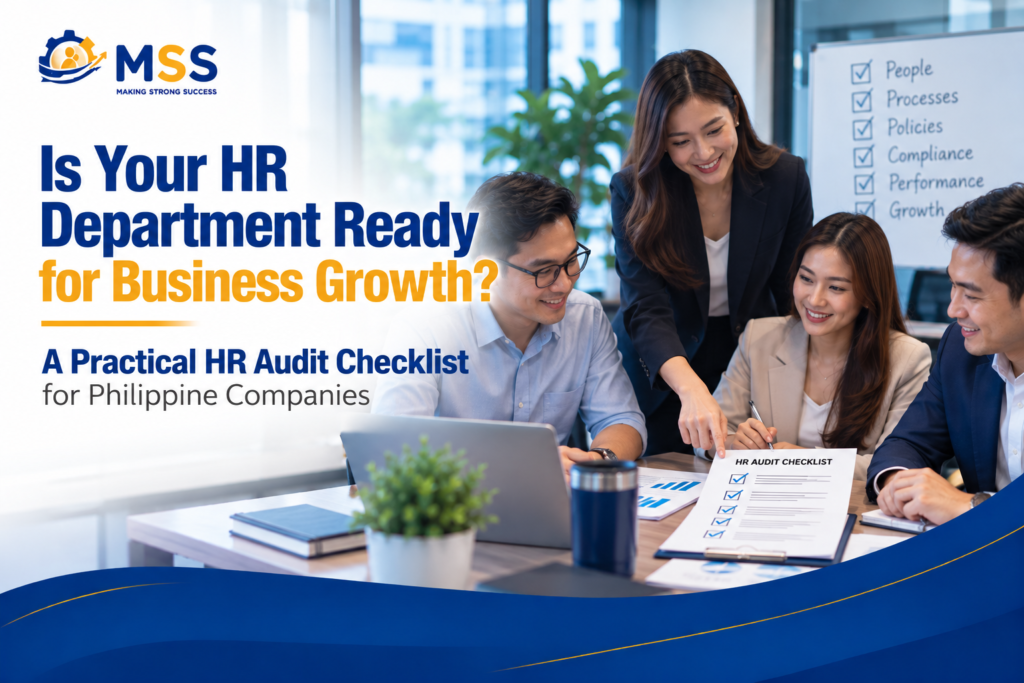
How business owners, executives, and HR leaders can assess their HR systems, identify operational gaps, and prepare their organizations for sustainable growth.
Your Business Is Growing. But Is Your HR Function Keeping Up?
Business growth is exciting. More clients. More projects. More employees. More opportunities.
But as organizations expand, the people management practices that worked during the early stages of the business may no longer be sufficient.
An HR team that once managed 20 employees may suddenly be supporting 80 or 150. Recruitment becomes more frequent. Managers need stronger people management skills. Employee concerns become more complex. Policies require greater consistency, and performance expectations become harder to coordinate.
At first, these challenges may appear to be isolated administrative problems.
A delayed recruitment request.
An outdated employee handbook.
An incomplete employee record.
A manager who is unsure how to address a performance issue.
But when these problems occur repeatedly, they may indicate something bigger: the organization’s HR systems have not developed at the same pace as the business.
This is where an HR audit becomes valuable.
An HR audit helps organizations examine whether their human resource policies, processes, systems, and management practices are appropriate for their current size, operational needs, and future direction.
For growing companies in the Philippines, conducting a structured HR audit can be an important step toward improving organizational effectiveness, reducing avoidable risks, and strengthening workforce performance.
What Is an HR Audit?
An HR audit is a systematic review of an organization’s human resource practices, policies, documentation, processes, and related management systems.
Its purpose is to identify what is working, what requires improvement, and which areas may expose the organization to operational, compliance, or people management risks.
An HR audit may examine areas such as:
- HR policies and employee documentation
- Recruitment and hiring procedures
- Employee onboarding and integration
- Job descriptions and organizational responsibilities
- Performance management systems
- Learning and development practices
- Compensation and benefits administration
- Employee relations and workplace procedures
- Workforce planning and talent management
- HR data, reporting, and process efficiency
The scope depends on the organization’s objectives.
Some audits focus primarily on HR compliance and documentation. Others take a broader approach, examining whether HR practices support business strategy, leadership effectiveness, employee performance, and organizational growth.
An HR audit is not simply about finding mistakes. It is about understanding whether the organization’s people management systems are fit for purpose.
Why Growing Companies Need to Review Their HR Systems
Business expansion increases organizational complexity.
When a company is small, owners and managers may rely on direct communication, informal procedures, and personal familiarity with employees.
As the workforce grows, those informal practices can become inconsistent or difficult to sustain.
1. More Employees Require More Consistent Processes
When HR decisions are handled differently across departments, employees may experience inconsistent expectations, documentation, and treatment.
A structured HR system helps establish clearer procedures and responsibilities.
2. Managers Need Better People Management Support
As teams expand, managers become responsible for more employees, performance conversations, development needs, and workplace concerns.
Without clear HR guidelines and appropriate management capability, similar situations may be handled differently across the organization.
3. HR Risks Become More Difficult to Monitor
Incomplete documentation, outdated policies, and inconsistent procedures may create administrative, employee relations, or legal concerns.
Periodic review helps organizations identify issues that require attention.
4. HR Must Support Business Decisions
Growth decisions often involve recruitment, workforce capacity, new roles, leadership requirements, and employee development.
HR needs reliable information and effective processes to contribute to these decisions.
5. Outdated Systems Can Slow Operations
Manual records, repeated approvals, unclear responsibilities, and disconnected HR processes can create unnecessary delays.
An audit helps determine whether current workflows remain efficient and appropriate.
A Practical HR Audit Checklist for Growing Philippine Companies
The following checklist can help business owners, HR leaders, and management teams conduct an initial assessment of their HR function.
It is a management review framework, not a substitute for a formal legal or regulatory compliance audit.
1. HR Policies and Employee Documentation
Key question: Are our HR policies clear, updated, consistently implemented, and properly documented?
Review whether the organization has:
- An updated employee handbook or relevant policy documents.
- Clearly communicated employment policies and procedures.
- Consistent employment documentation and recordkeeping.
- Defined procedures for handling employee concerns.
- Appropriate confidentiality and personal data protection practices.
- A process for reviewing and updating HR policies.
Potential warning signs:
Employees receive different interpretations of the same policy. HR relies on outdated templates. Managers are unsure which procedures to follow. Important records are incomplete or difficult to retrieve.
Recommended action: Conduct a policy and documentation review, identify inconsistencies, and prioritize updates based on operational needs and applicable legal requirements.
For Philippine employers, legal compliance should be reviewed against applicable labor laws, regulations, and official guidance, with qualified professional advice where necessary.
2. Recruitment and Hiring Processes
Key question: Are we hiring based on clearly defined workforce needs and job requirements?
Review whether:
- Hiring requests are connected to actual business requirements.
- Job descriptions reflect current responsibilities.
- Selection criteria are relevant and consistently applied.
- Recruitment responsibilities and approvals are clear.
- Candidate evaluation methods are appropriate for the role.
- Recruitment outcomes are reviewed periodically.
Potential warning signs:
Departments repeatedly request urgent hires. Positions are filled without clear job requirements. Recruitment decisions rely heavily on personal impressions. Newly hired employees discover that their actual responsibilities differ significantly from the advertised role.
Recommended action: Standardize recruitment requirements and establish clearer coordination between HR and hiring managers.
3. Employee Onboarding and Integration
Key question: Are new employees being prepared to succeed, or simply being introduced to the company?
Review whether:
- New hires receive a structured onboarding plan.
- Job expectations are explained clearly.
- Essential tools and system access are available.
- Managers conduct regular onboarding check-ins.
- Role-specific learning requirements are identified.
- Early performance milestones are established.
Potential warning signs:
New employees repeatedly ask the same basic questions. Managers expect immediate independence without adequate guidance. Onboarding ends after orientation. Early performance problems are discovered too late.
Recommended action: Develop a role-appropriate onboarding process with defined responsibilities, checkpoints, and performance expectations.
4. Job Descriptions, Roles, and Responsibilities
Key question: Does everyone understand what they are responsible for and what results they are expected to deliver?
Review whether:
- Job descriptions reflect actual work.
- Reporting relationships are clearly defined.
- Responsibilities are appropriately assigned.
- Decision-making authority is understood.
- Roles have relevant performance expectations.
- Overlapping or unassigned responsibilities are identified.
Potential warning signs:
Employees regularly say, “I thought another department was handling that.”
Managers repeatedly resolve ownership disputes. Important tasks fall between departments. Employees receive conflicting instructions.
Recommended action: Review role clarity and job design, particularly in departments affected by business expansion or operational changes.
5. Performance Management and Accountability
Key question: Do our performance management practices help employees understand expectations and improve results?
Review whether:
- Individual performance goals support team objectives.
- Performance indicators are relevant and understandable.
- Managers provide regular feedback.
- Performance issues are addressed consistently.
- Employee development needs are documented.
- Performance discussions lead to meaningful follow-through.
Potential warning signs:
Employees only receive feedback during annual evaluations. Performance ratings are inconsistent. Managers avoid difficult conversations. Repeated performance problems remain unresolved.
Recommended action: Strengthen goal-setting, feedback, coaching, performance monitoring, and manager accountability.
6. Learning, Training, and Employee Development
Key question: Are we developing capabilities that the organization actually needs?
Review whether:
- Training needs are identified systematically.
- Learning priorities reflect business requirements.
- Employees receive relevant development opportunities.
- Managers reinforce learning after training.
- Training effectiveness is evaluated beyond attendance.
- Critical skill and capability gaps are monitored.
Potential warning signs:
The organization conducts numerous training programs but sees limited workplace improvement. Employees attend workshops without applying what they learned. Development decisions are based mainly on available training topics.
Recommended action: Connect learning and development planning to actual performance requirements, competency gaps, and organizational priorities.
7. Compensation, Benefits, and HR Administration
Key question: Are compensation and HR administrative processes accurate, consistent, and properly controlled?
Review whether:
- Compensation policies and practices are documented.
- Payroll-related responsibilities are clearly assigned.
- Employee records are maintained appropriately.
- Statutory contributions and related obligations are reviewed.
- Leave and attendance procedures are consistently administered.
- Employee inquiries are handled through defined processes.
Potential warning signs:
Frequent payroll corrections, inconsistent benefit explanations, missing employee records, or repeated administrative delays.
Recommended action: Review administrative controls, documentation, process ownership, and relevant legal requirements.
In the Philippines, applicable obligations may involve labor regulations and agencies such as DOLE, SSS, PhilHealth, and Pag-IBIG Fund, depending on the issue and employer circumstances. Compliance findings should be validated against current official requirements.
8. Employee Relations and Workplace Culture
Key question: Do employees have clear, fair, and appropriate ways to raise workplace concerns?
Review whether:
- Employee concerns can be reported through appropriate channels.
- Workplace rules are communicated consistently.
- Managers understand escalation procedures.
- Employee feedback is reviewed constructively.
- Workplace concerns are handled with appropriate confidentiality.
- The organization monitors recurring employee relations issues.
Potential warning signs:
Employees avoid reporting problems. Similar concerns repeatedly emerge. Managers handle workplace issues inconsistently. Employees believe that raising concerns will lead to negative consequences.
Recommended action: Strengthen employee relations procedures, manager capability, communication channels, and workplace trust.
9. Workforce Planning and Talent Readiness
Key question: Do we understand the people and capabilities our business will need next?
Review whether:
- Workforce requirements are considered during business planning.
- Critical positions and capabilities are identified.
- Future staffing needs are discussed with department leaders.
- Talent gaps are monitored.
- Key roles have appropriate continuity or succession considerations.
- Hiring and development priorities reflect organizational direction.
Potential warning signs:
The company repeatedly reacts to staffing shortages. Critical work depends heavily on one employee. Expansion plans are announced before workforce requirements are assessed.
Recommended action: Align workforce planning with operational priorities, future capabilities, and realistic resource requirements.
10. HR Systems, Data, and Reporting
Key question: Can our HR function provide accurate information to support management decisions?
Review whether:
- Employee data is maintained accurately.
- HR reporting responsibilities are defined.
- Recruitment, turnover, attendance, and other relevant indicators are monitored.
- Data access is appropriately controlled.
- Reports provide meaningful management insights.
- HR processes are reviewed for inefficiencies and duplication.
Potential warning signs:
Management receives conflicting headcount figures. Reports require extensive manual consolidation. Important decisions rely on incomplete or outdated HR information.
Recommended action: Establish consistent HR data definitions, reporting practices, controls, and improvement priorities.
How to Prioritize HR Audit Findings
Completing an HR audit checklist is only the beginning.
The real value comes from deciding which findings require action and in what order.
Not every issue carries the same level of risk or business impact.
A practical approach is to classify findings into three priorities.
Priority 1: Critical Risks
Issues that may involve legal or regulatory noncompliance, serious employee welfare concerns, material data protection risks, or significant operational exposure.
These should receive prompt attention and, where appropriate, specialist review.
Priority 2: High-Impact Operational Gaps
Issues that may not be immediate compliance emergencies but significantly affect productivity, consistency, employee performance, or management effectiveness.
Examples include unclear responsibilities, recurring recruitment delays, weak performance management, and inconsistent onboarding.
Priority 3: Development and Optimization Opportunities
Areas where existing practices are functional but could become more effective, efficient, or scalable.
Examples include improving HR dashboards, strengthening learning evaluation, refining workflows, and developing manager capability.
Organizations can then establish an action plan with clear owners, timelines, required resources, and progress measures.
Who Should Participate in an HR Audit?
An HR audit should not necessarily be conducted by HR alone.
Depending on its scope, useful participants may include:
Business Owners and Senior Executives
To clarify business direction, growth priorities, organizational risks, and strategic expectations.
HR Leaders and Practitioners
To provide information about current HR systems, policies, processes, and operational challenges.
Department Managers
To explain how HR practices affect hiring, employee performance, workplace concerns, and day-to-day operations.
Finance and Operations Representatives
To contribute insights on workforce costs, process efficiency, controls, and operational requirements.
External HR Consultants or Relevant Specialists
To provide independent assessment, technical expertise, or assistance in areas requiring specialized knowledge.
The appropriate participants depend on the size of the organization and the purpose of the review.
How Often Should a Company Conduct an HR Audit?
There is no single schedule suitable for every organization.
The frequency should depend on the organization’s size, complexity, risk exposure, and rate of change.
A periodic HR review may be useful, with more focused assessments following significant organizational developments.
Consider conducting or updating an HR audit when:
- The company is expanding rapidly.
- Employee headcount has increased significantly.
- New branches, departments, or business units are being established.
- Major organizational restructuring is planned.
- HR processes are becoming increasingly difficult to manage.
- Employee relations concerns are recurring.
- The organization is implementing new HR technology.
- Leadership identifies gaps in people management practices.
- Important regulatory or operational requirements change.
The objective is to review HR readiness before avoidable problems become more expensive or disruptive.
HR Audit vs. HR Consulting: What Is the Difference?
An HR audit and HR consulting are related, but they are not identical.
An HR audit identifies and evaluates the current condition of HR practices and systems.
HR consulting helps organizations design, improve, implement, or strengthen solutions based on identified needs.
For example, an audit may reveal that managers apply performance standards inconsistently.
The resulting improvement initiative might involve reviewing performance indicators, revising procedures, clarifying manager responsibilities, providing management training, or strengthening feedback systems.
Similarly, an audit may identify gaps in onboarding.
The solution may involve developing onboarding guidelines, defining manager responsibilities, improving orientation materials, and establishing employee readiness checkpoints.
An audit creates the basis for informed action.
Consulting and implementation support help translate that assessment into organizational improvements.
How MSS Corporation Can Help Strengthen Your HR Systems
As an Organization & People Solutions provider in the Philippines, MSS Corporation supports businesses seeking to improve their people management practices, organizational effectiveness, and workforce performance.
Through its HR consulting, organizational development, leadership development, corporate training, and related solutions, MSS can help organizations examine and address gaps affecting people and business results.
Depending on the organization’s requirements, support may include:
Strategic HR Consulting
Reviewing HR policies, processes, people management practices, and organizational requirements to identify appropriate improvement priorities.
Organizational Development Consulting
Examining how structures, responsibilities, workflows, and organizational systems influence operational effectiveness.
Leadership and Management Development
Strengthening managers’ capabilities in communication, coaching, performance management, accountability, and employee development.
Customized Corporate Training
Addressing identified knowledge and competency gaps through learning interventions aligned with actual workplace needs.
Performance Management Solutions
Improving goal-setting, performance expectations, feedback, monitoring, and employee development practices.
Workforce Planning and Talent Optimization
Helping organizations connect people requirements and talent decisions with current and future business priorities.
The goal is not simply to identify HR problems.
It is to help organizations determine what improvements will make their people systems more effective and better aligned with business objectives.
Conclusion: Business Growth Requires HR Systems That Can Grow With It
Many companies invest significant effort in expanding operations, increasing sales, and acquiring new customers.
But sustainable growth also requires attention to the internal systems that support employees and managers.
An HR function that operates effectively today may need different processes, capabilities, and controls as the organization becomes larger and more complex.
Conducting a structured HR audit helps business leaders identify gaps before they become recurring operational problems.
It provides an opportunity to examine whether HR policies remain relevant, whether managers have sufficient support, whether employee processes are consistent, and whether people management practices contribute to business performance.
The question is not simply whether your HR department is busy.
The more important question is whether your HR systems are ready to support where your business is going.
Is Your HR Function Ready for Your Next Stage of Growth?
If your organization is experiencing inconsistent HR practices, outdated processes, recurring people management issues, or challenges supporting business expansion, it may be time for a structured review.
Connect with MSS Corporation to explore how strategic HR consulting, organizational development, leadership development, and customized corporate training can help strengthen your people systems and organizational performance.
Partner with MSS Corporation
If your organization is looking for a trusted partner in organization development, HR consulting, leadership development, and corporate training, MSS Corporation is ready to help.
Together, let’s build a workforce that is capable, confident, and future-ready.
If you enjoy reading, please visit our other articles for more interesting content.
To know more about Making Strong Success (MSS) Corporation, click our social media pages below: