How organizations can identify leadership readiness, avoid costly promotion mistakes, and develop stronger first-time managers.
This opens a much cleaner content cluster around:
Leadership Readiness → First-Time Managers → Management Development → Leadership Pipeline → HR Consulting → Organization & People Solutions
It also supports MSS’s existing positioning around leadership and management development without simply creating another training-program landing page. MSS already presents leadership development as part of its broader organization and people solutions, so this article can function as an educational, problem-awareness entry point.
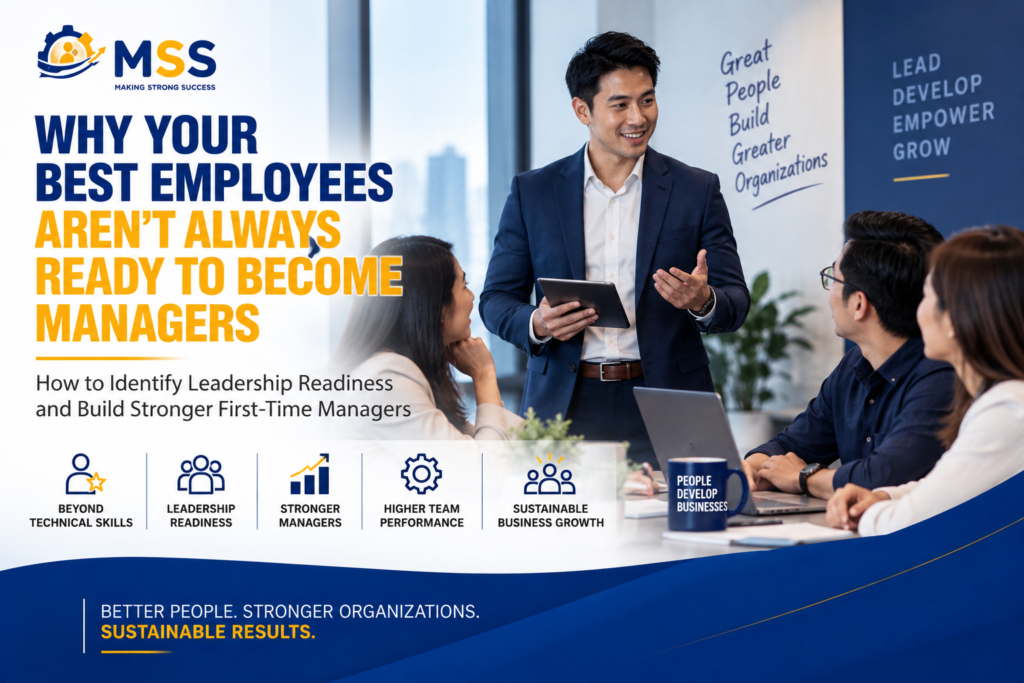
Why Your Best Employees Aren’t Always Ready to Become Managers
One of your strongest employees gets promoted.
- They know the business.
- They consistently deliver results.
- They solve problems quickly.
- Their technical expertise is respected by the team.
So making them a manager seems like the obvious next step.
Then something changes.
The high performer who once excelled independently begins struggling to delegate. Team members receive inconsistent direction. Difficult conversations are avoided. Performance issues linger. The new manager becomes overwhelmed because they are still doing much of their old job while trying to lead other people.
The promotion looked right on paper.
But the organization may have confused high performance with leadership readiness.
That distinction matters.
A great individual contributor can become an excellent manager—but strong performance in one role does not automatically prove readiness for another.
High Performance and Leadership Readiness Are Different
Individual contributors are often rewarded for what they personally accomplish.
Managers are increasingly responsible for what their team accomplishes.
That is a fundamental shift.
Before promotion, success may depend heavily on technical knowledge, individual productivity, expertise, reliability, and personal execution.
After promotion, success increasingly requires:
- Setting clear expectations
- Delegating effectively
- Coaching employees
- Giving feedback
- Managing performance
- Resolving conflict
- Making decisions
- Prioritizing team resources
- Communicating across levels
- Holding people accountable
- Developing others
The employee is no longer responsible only for doing the work well.
They must learn how to create the conditions for other people to perform well.
Why Companies Promote Their Best Performers
Promoting strong performers is understandable.
Organizations want to reward people who consistently contribute. Internal candidates already understand the business, customers, processes, and culture. Promoting from within can also create visible career opportunities for employees.
The problem is not internal promotion.
The problem occurs when organizations use past individual performance as the primary evidence of future managerial effectiveness.
Performance should be considered—but it should not be the only consideration.
1. Technical Expertise Does Not Automatically Equal People Leadership
Someone can be exceptional at accounting, engineering, sales, operations, IT, marketing, or another technical discipline without yet knowing how to manage people.
These are different capability sets.
A technical expert may instinctively solve a problem themselves because that has always been the fastest route to success.
A manager often needs to resist that instinct.
Instead of immediately taking over, the manager may need to ask questions, coach the employee, clarify expectations, provide resources, and allow the person to solve the problem.
That transition—from expert problem solver to people enabler—can be difficult.
2. They Struggle to Let Go of Their Previous Responsibilities
A newly promoted manager may still identify strongly with their previous role.
They continue handling technical tasks because they know they can do them well.
At first, this can appear productive.
But eventually the manager becomes overloaded.
Meanwhile, employees may become dependent on them.
Every difficult task goes back to the manager. Decisions accumulate. Team members have fewer opportunities to develop.
The manager becomes a bottleneck.
Leadership requires learning what to continue doing, what to stop doing, and what to delegate.
3. They Give Answers Instead of Developing People
High performers are often accustomed to knowing the answer.
Managers need another capability: helping other people discover and execute the answer.
That requires coaching.
Instead of saying:
“Here’s what you need to do.”
effective managers increasingly learn to ask:
“How would you approach this?”
“What’s preventing you from moving forward?”
“What options have you considered?”
The objective is not to withhold support.
It is to develop employees who can eventually operate with greater capability and independence.
4. Difficult Conversations Become Difficult to Avoid
Managing people involves conversations that individual contributors may rarely have to lead.
A manager may need to address:
- Missed expectations
- Poor performance
- Behavioral problems
- Team conflict
- Attendance concerns
- Accountability issues
- Resistance to change
- Development gaps
Technical expertise does not necessarily prepare someone for these conversations.
New managers may delay them because they are uncomfortable, particularly when they were recently peers with the people they now supervise.
But unresolved issues rarely disappear simply because a manager avoids discussing them.
5. They Want to Be Liked More Than They Want to Lead
The transition from peer to manager can be especially challenging.
Yesterday, the employee was part of the group.
Today, they may need to evaluate performance, enforce standards, distribute work, make unpopular decisions, and hold former peers accountable.
Some new managers respond by becoming overly controlling.
Others move in the opposite direction and become reluctant to set boundaries because they do not want relationships to change.
Effective management requires a balance between trust and accountability.
6. They Have Never Been Taught How to Manage Performance
Organizations sometimes promote employees into management and assume they will learn leadership through experience.
Experience matters.
But experience without guidance can also reinforce poor management habits.
New managers need to understand how organizational objectives translate into team expectations, individual responsibilities, measurable results, feedback, coaching, and accountability.
Otherwise, performance management can become something they do only when HR requests an appraisal form.
Management should happen throughout the performance cycle—not only during evaluation season.
7. They Are Still Measured Like Individual Contributors
Sometimes the new manager is not the only problem.
The system around them has not changed.
A company promotes someone to lead a team but continues measuring and rewarding them primarily for their personal output.
The predictable result?
They keep behaving like an individual contributor.
Organizations should examine whether the manager’s KPIs, responsibilities, authority, workload, and expectations actually reflect the leadership role they have been asked to perform.
8. They Were Promoted Without a Development Plan
Promotion should not be the end of leadership development.
It should often be the beginning.
A newly promoted manager may benefit from a structured transition that includes:
Management training → Coaching → Feedback → Application → Reflection → Continued development
The exact intervention will depend on the individual and organization.
The important point is that organizations should not simply hand someone a new title and expect leadership capability to appear automatically.
Before Promoting Someone, Assess Leadership Readiness
Instead of asking only:
“Who is our best performer?”
organizations can ask broader questions:
Does this person demonstrate the potential and willingness to lead others?
Can they communicate expectations clearly?
How do they respond to conflict?
Can they give and receive feedback?
Do they take accountability?
Can they delegate?
Do other people trust their judgment?
Are they interested in developing people—or simply attracted to the title and compensation?
That last question deserves particular attention.
Not every exceptional specialist wants to become a manager.
And they should not necessarily have to.
Create Career Growth Beyond Management
When management is the only visible path to higher status, compensation, or career advancement, organizations can unintentionally push excellent specialists into roles they neither want nor suit.
A stronger talent strategy may create opportunities for both:
Leadership progression and specialist/expert progression.
This allows organizations to retain valuable expertise while reserving people-management roles for employees who demonstrate appropriate readiness and interest.
What If You’ve Already Promoted Them?
A struggling first-time manager is not automatically a failed manager.
They may simply be underprepared.
Organizations can examine what is causing the difficulty.
Is it a capability gap?
Unclear expectations?
An excessive workload?
Insufficient authority?
Lack of coaching?
Poor role design?
No management training?
Weak support from their own leader?
Different causes require different solutions.
The answer should not automatically be to remove the manager—or send them to another generic leadership seminar.
Start with diagnosis.
Build Managers Before You Need Them
The strongest time to develop leadership capability is not necessarily after someone receives a management title.
Organizations can identify potential leaders earlier and give them opportunities to develop.
That might include:
- Leading projects
- Mentoring colleagues
- Facilitating meetings
- Solving cross-functional problems
- Handling increasingly complex responsibilities
- Receiving coaching
- Participating in leadership development
- Gathering structured feedback
These experiences allow organizations to observe potential while helping employees understand what leadership actually requires.
From High Performer to Effective Manager
The goal is not to stop promoting high-performing employees.
It is to make promotion decisions more intentionally.
Organizations need strong individual contributors.
They also need strong managers.
Sometimes those will be the same people—but organizations should not assume they will be.
A successful transition requires the right combination of readiness, role clarity, capability development, organizational support, feedback, and experience.
How MSS Corporation Can Help
MSS Corporation helps organizations strengthen both individual and organizational capability through integrated Organization & People Solutions.
Depending on the organization’s needs, interventions may include leadership and management development, coaching, competency development, performance management, organizational assessment, HR consulting, customized corporate training, and broader organizational development solutions.
Rather than treating leadership development as a one-time event, organizations can build systems that help identify, prepare, support, and continuously develop managers.
Don’t Wait Until Your New Managers Struggle
Every promotion into management changes more than one person’s job.
It can affect the performance, engagement, development, and experience of an entire team.
Before promoting your next high performer, ask a better question:
“Are they excellent at what they do—or are they also ready to help other people become excellent at what they do?”
That distinction can shape the quality of your organization’s next generation of leaders.
Partner with MSS Corporation
If your organization is looking for a trusted partner in organization development, HR consulting, leadership development, and corporate training, MSS Corporation is ready to help.
Together, let’s build a workforce that is capable, confident, and future-ready.
If you enjoy reading, please visit our other articles for more interesting content.
To know more about Making Strong Success (MSS) Corporation, click our social media pages below: