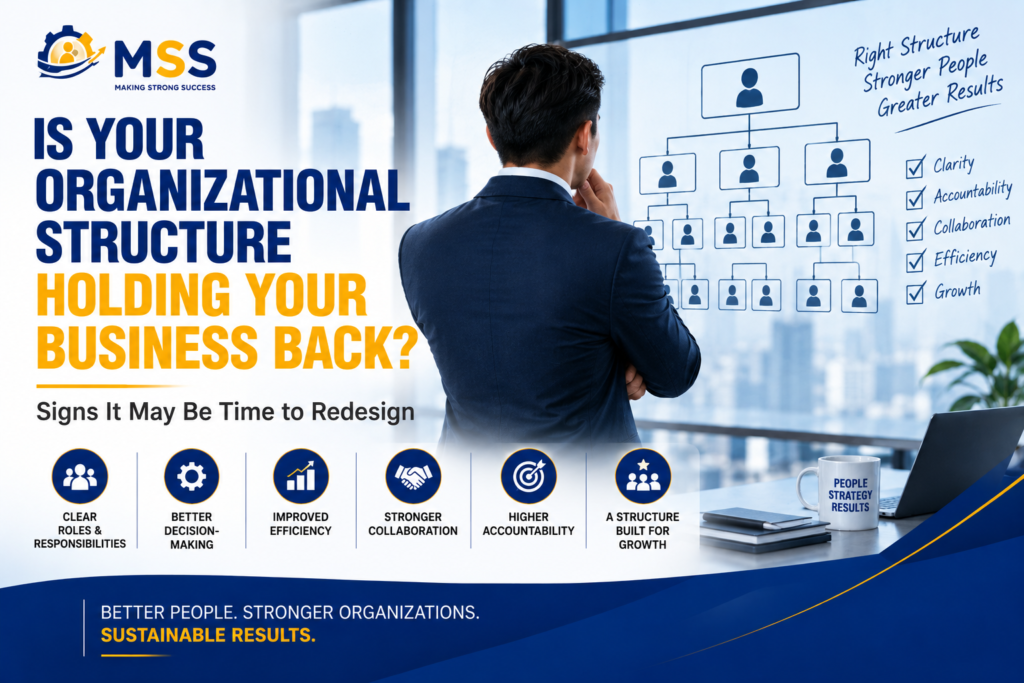
Business growth often changes faster than organizational structure.
A company may begin with a small team where everyone communicates directly, employees perform multiple roles, and the owner remains involved in most decisions.
That structure can work remarkably well—until the business grows.
More employees join. New departments emerge. Managers are promoted. Responsibilities expand. Additional approval layers appear. Decisions become more complicated.
Eventually, an organization may discover that the structure that helped it reach its current size is no longer the structure it needs for its next stage.
The problem is not necessarily the people.
Sometimes, the way the organization is designed is making good performance unnecessarily difficult.
What Is Organizational Structure?
Organizational structure defines how work, responsibilities, authority, and accountability are arranged within a company.
It influences questions such as:
- Who is responsible for what?
- Who reports to whom?
- Who has authority to make decisions?
- How do departments work together?
- Where does accountability sit?
- How does information move through the organization?
An organizational chart may visually represent this structure, but organization design goes much deeper than boxes and reporting lines.
An effective structure should help people execute the company’s strategy.
Why Organizational Structures Stop Working
Businesses evolve.
The structure that works for a 15-person organization may not work effectively when the company reaches 50, 100, or several hundred employees.
New products, locations, customers, technologies, and business models can also change what an organization requires.
Problems emerge when the business changes but its organizational design does not.
Leaders may continue adding positions and departments without reconsidering how responsibilities, decision rights, workflows, and accountability should operate together.
The result can be organizational complexity without organizational effectiveness.
1. Roles and Responsibilities Are Unclear
One of the strongest signs of a structural problem is hearing:
“I thought they were responsible for that.”
When responsibilities overlap—or important responsibilities belong to no one—work can fall through the cracks.
Employees may duplicate tasks, managers may issue conflicting instructions, and departments may disagree over ownership.
Clear organizational design establishes not only job titles but also accountability for results.
2. Too Many Decisions Still Depend on the Owner or CEO
In growing businesses, founders and senior executives often remain involved in decisions they personally handled when the company was smaller.
Over time, this can create a bottleneck.
Employees wait for approvals. Managers hesitate to act. Senior leaders become overwhelmed with operational decisions.
The organization may have grown in headcount without growing its decision-making capacity.
Effective organization design distributes appropriate authority while maintaining accountability.
3. Managers Have Too Many—or Too Few—Direct Reports
Managerial spans can significantly affect organizational effectiveness.
A manager responsible for too many people may struggle to provide adequate coaching, direction, feedback, and performance management.
On the other hand, excessive layers of management can slow communication and decision-making.
There is no universal number that works for every organization. The appropriate structure depends on the complexity of the work, employee capability, managerial responsibilities, and operating environment.
The goal is to create manageable and purposeful layers—not hierarchy for hierarchy’s sake.
4. Departments Operate in Silos
Marketing blames Sales.
Sales blames Operations.
Operations blames Procurement.
HR struggles to get managers involved.
Finance receives information too late.
When departments optimize their own activities without understanding how their work affects others, organizational performance suffers.
Silos can be cultural, but they can also be structural.
Reporting relationships, KPIs, processes, incentives, and decision rights can unintentionally encourage departments to work independently instead of collaboratively.
5. Work Is Being Duplicated
As organizations expand, similar responsibilities can develop in different teams.
Two departments may maintain separate versions of the same data. Multiple employees may perform overlapping administrative tasks. Different units may independently create processes that should be shared.
Duplication increases costs and can create inconsistent standards.
Organization design helps determine where work should reside and how responsibilities should be coordinated.
6. Accountability Is Difficult to Determine
When a result is missed, can leaders quickly identify who owns it?
If accountability is consistently unclear, the issue may extend beyond individual performance.
Responsibilities may be fragmented across too many roles, authority may not match accountability, or KPIs may not correspond with the organization’s structure.
A well-designed organization makes ownership visible.
People should understand not only what activities they perform but also what results they are accountable for producing.
7. The Organization Has Added People but Performance Hasn’t Improved
Hiring more employees does not automatically increase organizational capacity.
If processes, roles, decision rights, leadership structures, and workflows remain unclear, additional headcount may simply add complexity.
This is why workforce planning and organization design should work together.
Before adding another position, organizations should ask:
Does this role solve a genuine capacity or capability requirement—or are we adding another person to compensate for a structural problem?
8. Your Structure No Longer Supports Your Strategy
This is perhaps the most important sign.
Strategy determines what the organization is trying to accomplish.
Structure determines how people organize themselves to accomplish it.
- If a business wants faster innovation but requires numerous approval layers, its structure may contradict its strategy.
- If customer experience is a priority but customer responsibilities are fragmented across departments, execution becomes difficult.
- If expansion is the objective but every major decision depends on one executive, growth may eventually stall.
Structure should follow strategy—not fight against it.
Organizational Redesign Is More Than Moving Boxes
When organizations hear “restructuring,” they sometimes immediately think about reducing headcount.
But organizational redesign does not automatically mean downsizing.
It can involve examining:
- Roles and responsibilities
- Reporting relationships
- Management layers
- Decision-making authority
- Departmental responsibilities
- Workflows
- Span of control
- Job design
- Capability requirements
- Accountability
- Cross-functional collaboration
The purpose is to determine how the organization can operate more effectively.
Start With Diagnosis, Not the Organizational Chart
A common mistake is redesigning the org chart before understanding the problem.
Moving boxes around may create the appearance of change without improving performance.
Organizations should first examine:
Strategy → Work → Processes → Capabilities → Roles → Structure → People
This sequence matters.
The organization needs to understand what it is trying to accomplish, what work must be performed, and what capabilities are required before deciding how positions should be arranged.
When Should Organizations Consider Organizational Redesign?
A structural review may be valuable when an organization is experiencing:
- Rapid business growth
- Expansion into new markets
- Merger or acquisition
- Major strategic changes
- Increasing operational complexity
- Persistent accountability issues
- Leadership bottlenecks
- Departmental silos
- Role duplication
- Excessive management layers
- Significant technology or process changes
Organizations do not need to wait until the structure becomes dysfunctional.
Periodic review can help ensure the organization remains aligned with its strategy.
How HR Contributes to Organization Design
HR has an important role in organizational design because structural decisions directly affect people.
HR can help leaders examine job responsibilities, competencies, workforce requirements, performance expectations, career paths, leadership capabilities, and talent implications.
But organizational design should not be treated solely as an HR exercise.
Senior leadership, operations, finance, and other relevant functions should participate because the structure ultimately exists to enable business performance.
How MSS Corporation Can Help
MSS Corporation approaches organizational challenges from both the business and people perspective.
Through organization and people solutions, HR consulting, organizational development, management consulting, strategic planning, workforce planning, leadership development, performance management, and customized interventions, MSS can help organizations examine whether their current structure supports their strategy and operating requirements.
The objective is not simply to create a better-looking organizational chart.
It is to help create an organization where:
- People know what they own.
- Managers can lead effectively.
- Decisions happen at the right level.
- Departments collaborate.
- Resources are used effectively.
- And structure supports strategy.
Build the Organization Your Strategy Requires
Organizations often invest heavily in strategy, technology, training, and recruitment.
But all of these investments operate inside an organizational structure.
When that structure creates confusion, bottlenecks, duplication, or unclear accountability, even talented employees can struggle to perform at their best.
Sometimes the next stage of growth does not begin by hiring more people.
It begins by asking whether the organization is designed to make the best use of the people it already has.
Is Your Organization Designed for Its Next Stage of Growth?
If your organization is experiencing unclear responsibilities, decision bottlenecks, duplicated work, departmental silos, or growing complexity, it may be time to review how your organization is structured.
MSS Corporation can help organizations diagnose organizational challenges and determine appropriate solutions aligned with their people, strategy, and business objectives.
Partner with MSS Corporation
If your organization is looking for a trusted partner in organization development, HR consulting, leadership development, and corporate training, MSS Corporation is ready to help.
Together, let’s build a workforce that is capable, confident, and future-ready.
If you enjoy reading, please visit our other articles for more interesting content.
To know more about Making Strong Success (MSS) Corporation, click our social media pages below: