Follow-Through Training Case Study: Measurable Kirkpatrick Level 3 Behavior Transfer Among Offshore Leaders in the Philippines
How Making Strong Success (MSS) Corporation Helped Leaders Turn Training Into Actual Workplace Follow-Through
What should companies look for when comparing training providers in the Philippines?
Not simply whether participants enjoyed the program.
Not simply whether the trainer received high evaluation scores.
And not simply whether employees learned something new during the session.
The more important question is:
Did participants actually use what they learned when they returned to work?
That is exactly what Making Strong Success (MSS) Corporation sought to examine after delivering a two-session Follow-Through Mastery training program for leaders of a Manila-based regional operating headquarters of an international financial services organization.
The intervention was conducted through two half-day sessions on March 12 and March 25, 2026.
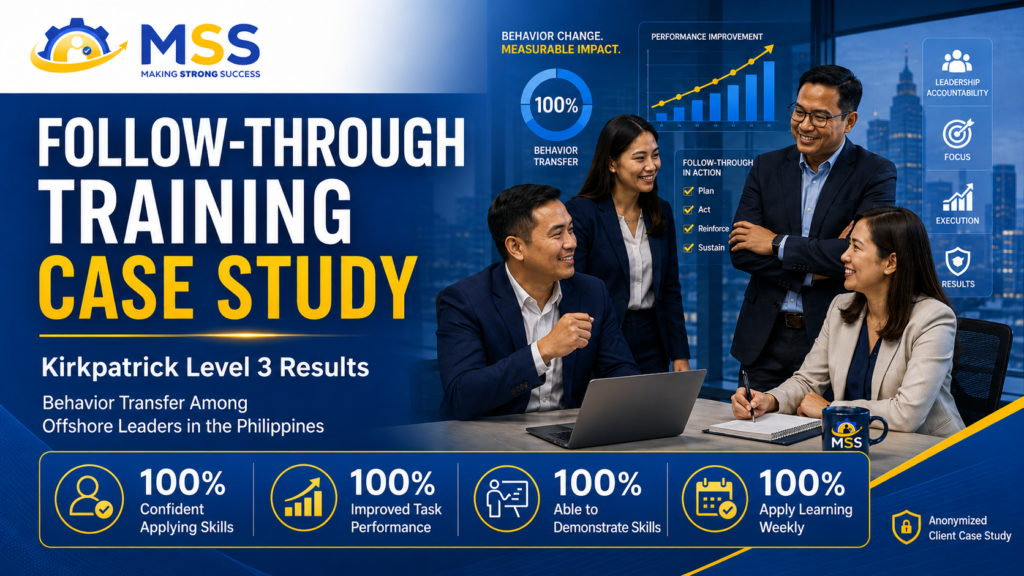
A subsequent anonymous transfer-of-learning survey produced encouraging evidence of workplace application: among the six leaders who responded, 100% reported confidence in applying the skills, 100% reported improved task performance, 100% reported being able to demonstrate the skills taught, and every respondent reported applying the learning at least once a week.
The findings provide an example of why organizations evaluating training and consultancy companies in the Philippines should look beyond training-day satisfaction and examine what happens after participants return to their actual jobs.
Case Study at a Glance
| Case Study Element | Details |
|---|---|
| Client | An anonymized Manila-based regional operating headquarters in the financial-services sector |
| Participants | Leaders from multiple operational and support functions |
| Intervention | Follow-Through Mastery for Offshore Leaders |
| Program Theme | The Last Mile |
| Format | Two half-day, face-to-face leadership-development sessions |
| Training Dates | March 12 and March 25, 2026 |
| Training Provider | Making Strong Success (MSS) Corporation |
| Evaluation Approach | Anonymous post-training Transfer of Learning Survey |
| Respondents | 6 leaders |
| Attendance Profile | 5 respondents attended both sessions; 1 reported attending the March 12 session |
| Primary Evaluation Focus | Workplace application and Kirkpatrick Level 3 behavior-transfer indicators |
| Privacy Approach | Company and participant identities withheld; results reported only in aggregated or de-identified form |
The Short Answer: Did the Training Transfer to the Workplace?
Yes, the respondents reported substantial transfer of learning into their work.
Among the six respondents:
- 83.3% agreed or strongly agreed that they had already applied the training learnings at work.
- 100% agreed or strongly agreed that they felt confident applying the skills learned.
- 100% agreed or strongly agreed that the training improved how they performed their tasks.
- 100% agreed or strongly agreed that they were able to demonstrate the skills taught.
- 100% reported applying the learning at least once a week.
- 83.3% reported using the learning daily or several times a week.
- 100% reported improvement in their communication or work approach.
- 100% reported that the training helped them handle work challenges better.
- 83.3% reported improved productivity.
- 83.3% reported better team collaboration.
There were also no Disagree or Strongly Disagree responses across any of the 20 Likert-scale evaluation statements contained in the survey.
The strongest opportunity for further improvement was not comprehension or individual skill application. It was team-level diffusion: only 50% positively agreed that they had already shared or discussed the training learnings with their teams.
That distinction is important.
It suggests that the next stage is not simply to teach participants more. It is to strengthen the mechanisms that turn individual behavior change into team routines, management practices, and organizational habits.
The Business Challenge: When Good Intentions Fail at the “Last Mile”
The Follow-Through Mastery intervention was designed around a familiar organizational problem:
People may know what to do.
They may even intend to do it.
But work still gets delayed, forgotten, misunderstood, or lost between people and teams.
Typical follow-through failures include:
- vague requests;
- unclear ownership;
- unclear deadlines;
- undefined expectations of what “done” actually means;
- hidden dependencies;
- incomplete handoffs;
- missing progress updates;
- failure to escalate risks early;
- actions agreed during meetings but never captured;
- and commitments that disappear among emails, chats, meetings, and competing priorities.
For offshore and cross-functional leaders, these problems can become even more costly because delays do not always remain local.
An incomplete handoff can create another cycle of clarification.
An unresolved dependency can delay a decision.
An uncommunicated problem can cause another stakeholder to follow up unnecessarily.
And repeated follow-ups eventually affect trust.
The objective of the intervention was therefore not simply to teach productivity techniques.
It was to strengthen reliable execution.
The Training Intervention: “The Last Mile — Follow-Through Mastery for Offshore Leaders”
MSS Corporation designed the intervention around practical behaviors that participants could immediately apply after training.
Session 1: Strengthening Individual Follow-Through
The first session focused on building the personal disciplines required to turn conversations, requests, and agreements into completed commitments.
Participants worked on areas such as:
Commitment Language That Sticks
Participants learned to convert vague tasks into explicit commitments.
A commitment needed to establish:
Owner + Deliverable + Due Date + Definition of Done
Instead of assuming that everybody interpreted an instruction the same way, participants were encouraged to clarify:
What exactly is the deliverable?
When is it due?
What does “done” actually look like?
Are there dependencies or approvals involved?
Who needs to know when the work has been completed?
Closed-Loop Communication
Follow-through does not only mean completing an assignment.
It also means closing the communication loop.
Participants examined how silence can cause uncertainty, unnecessary follow-ups, stalled work, and declining stakeholder confidence.
They practiced communicating progress, risks, changes, and completion rather than leaving stakeholders to guess what happened.
Better Handoffs
Participants practiced structured handoffs built around clear tasks, owners, deadlines, and definitions of completion.
The intention was to reduce the risk of work “falling between teams” simply because information was incomplete when responsibility changed hands.
Personal Follow-Through Systems
Participants were also encouraged to capture commitments immediately rather than relying on memory.
Actions coming from meetings, chats, email, stakeholder requests, and handoffs needed to become visible, trackable commitments.
Session 2: Turning Individual Discipline Into Team-Level Follow-Through
The second session expanded the focus from individual execution to team and cross-functional execution.
The session addressed:
Ownership at Scale
Participants explored clearer responsibility and accountability using tools such as RACI so that assignments would not remain ambiguous between individuals or functions.
Action Registers and Follow-Through Cadence
Instead of allowing commitments to live across scattered messages and meeting notes, leaders examined the value of maintaining a visible action register and reviewing it at a predictable cadence.
Metrics That Drive Behavior
Participants connected follow-through with measurable indicators rather than relying entirely on impressions about whether execution was improving.
Cross-Team Handoffs and Close-Outs
The training reinforced the idea that a handoff is not complete simply because information has been sent.
The receiving party must have enough clarity to continue the work, while completion should also be communicated back to the appropriate stakeholders.
Obstacle Busting and Escalation
Participants examined how barriers, dependencies, and risks should be surfaced early enough for leaders to act on them rather than discovering problems only after deadlines have already been missed.
90-Day Follow-Through Planning
The intervention concluded by moving participants toward a longer-term implementation plan built around visible follow-through mechanisms, including an action register, recurring review cadence, and measurable indicators with identified ownership.
This was an important design principle of the program:
Training was treated as the beginning of application—not the end of the intervention.
Kirkpatrick Level 3 Results: What Happened Back at Work?
Kirkpatrick Level 3 focuses on whether learning translates into behavior in the participant’s actual working environment.
The survey therefore included several direct indicators of workplace application.
1. Participants Were Applying the Learning
83.3% of respondents agreed or strongly agreed:
“I have applied the learnings from the training in my work.”
The average score was 4.00 out of 5.00.
One respondent selected Neutral. No respondent disagreed.
This matters because learning transfer requires more than understanding a concept during a workshop. Participants must actually use it when dealing with real responsibilities, stakeholders, deadlines, and constraints.
2. All Respondents Reported Confidence in Applying the Skills
100% agreed or strongly agreed:
“I feel confident in applying the skills learned.”
Average rating: 4.17 out of 5.00
Confidence alone does not prove behavior change, but it is an important enabling condition. Employees who understand a technique but do not feel capable of using it are less likely to transfer learning consistently.
3. All Respondents Reported Improvement in Task Performance
100% agreed or strongly agreed:
“The training helped improve how I perform my tasks.”
Average rating: 4.50 out of 5.00
Half of the respondents selected Strongly Agree.
This was one of the strongest results in the survey and suggests that participants did not view the training merely as interesting or theoretical. They connected it with the way they actually performed their work.
4. All Respondents Reported Being Able to Demonstrate the Skills
100% agreed or strongly agreed:
“I am able to demonstrate the skills taught during the session.”
Average rating: 4.33 out of 5.00
This is particularly important for behavior-transfer evaluation because demonstration is closer to observable performance than simple recollection of training content.
5. Application Was Happening Repeatedly—not Merely Once
Participants were asked how frequently they applied what they learned.
The results were:
| Frequency of Application | Respondents | Percentage |
| Daily | 2 | 33.3% |
| Several times a week | 3 | 50.0% |
| Once a week | 1 | 16.7% |
Therefore:
100% of respondents reported applying the training at least weekly.
And:
83.3% reported applying it daily or several times per week.
For a follow-through program, frequency is especially meaningful because follow-through is not a one-time technique. It is a recurring behavioral discipline.
The Biggest Level 3 Opportunity: Spreading the Behavior to the Team
One result was noticeably lower than the others.
Only 50% agreed or strongly agreed:
“I have shared or discussed the training learnings with my team.”
Average rating: 3.67 out of 5.00
Three respondents selected Neutral.
This represents an important next-stage opportunity.
Individual leaders can improve their own execution, but lasting organizational improvement becomes more likely when the same behaviors become part of team expectations.
For example:
A leader defining a clear Definition of Done is useful.
A whole team consistently using Definitions of Done is a system.
A leader maintaining a personal action list is useful.
A team maintaining and reviewing one visible action register is a management process.
A leader communicating risks early is useful.
A culture in which everybody is expected to escalate risks early becomes an organizational capability.
The survey therefore suggests that the next leverage point is behavioral cascade and reinforcement at team level.
Self-Reported Workplace Impact
Although these survey responses should not be treated as objective proof of company-level financial or operational results, the respondents also reported encouraging changes in how they worked.
Productivity
83.3% agreed or strongly agreed that the training improved their productivity.
Average rating: 4.00 out of 5.00
One respondent selected Neutral.
Communication and Work Approach
100% agreed or strongly agreed that the training improved their communication or work approach.
Average rating: 4.33 out of 5.00
This result is particularly relevant because strong follow-through depends heavily on how commitments, updates, risks, deadlines, and completions are communicated.
Handling Work Challenges
100% agreed or strongly agreed that the training helped them handle work challenges better.
Average rating: 4.33 out of 5.00
Team Collaboration
83.3% agreed or strongly agreed that the training contributed to better team collaboration.
Average rating: 4.17 out of 5.00
One respondent selected Neutral.
Were Participants Supported in Applying the Training?
Behavior change does not happen in isolation.
Even highly motivated employees may struggle to use new skills when their environment does not provide the necessary support, resources, opportunities, systems, or reinforcement.
The survey therefore examined two important transfer conditions.
Manager Support
83.3% agreed or strongly agreed:
“I receive enough support from my manager to apply what I learned.”
Average rating: 4.33 out of 5.00
One respondent selected Neutral.
Opportunity to Apply
83.3% agreed or strongly agreed:
“I have enough opportunities to apply the training in my job.”
Average rating: 4.33 out of 5.00
One respondent selected Neutral.
The results indicate generally favorable workplace conditions, while also showing that transfer conditions were not equally strong for every participant.
What Was Preventing Application?
The open-ended responses revealed several practical barriers.
Specific barriers mentioned included:
- not yet feeling fully confident;
- lack of resources or tools;
- and lack of opportunity to apply the learning.
One respondent selected an “Other” category without providing additional explanation, while two respondents did not identify a specific barrier.
This provides an important lesson for organizations investing in corporate training:
A training provider can build capability, but the workplace must still enable the behavior.
When application is constrained by tools, opportunities, workflow, management practices, or organizational systems, additional training alone may not solve the entire problem.
Did Participants Actually Learn the Material?
The transfer results were supported by consistently strong learning-related responses.
| Learning Indicator | Positive Responses | Average / 5 |
| Clearly understood the key concepts | 100% | 4.67 |
| Training objectives were clearly explained | 100% | 4.67 |
| Gained new knowledge or insights relevant to the role | 100% | 4.50 |
| Examples and activities improved understanding | 100% | 4.50 |
Across these four learning indicators, the aggregate average was approximately 4.58 out of 5.00, with 100% positive responses.
This creates an important progression:
Participants understood the learning → felt capable of using it → reported demonstrating it → and reported applying it repeatedly at work.
That is a much stronger evidence chain than a training evaluation that stops at “Did you enjoy the seminar?”
What Participants Found Most Useful
The qualitative feedback reinforced the quantitative findings.
Participants identified several particularly useful aspects of the program:
Practical Application Activities
Participants specifically valued opportunities to practice the concepts rather than only hearing them explained.
Definition of Done
One respondent specifically highlighted the importance of clearly stating the Definition of Done, reinforcing the practical value of converting vague expectations into observable completion standards.
Peer Participation
Participant interaction and learning from fellow leaders were also identified as useful.
Real-World Application
The use of realistic situations and the facilitator’s application of concepts to actual workplace contexts were specifically appreciated.
Group Activities
Several respondents identified group activities or activity portions as among the most useful elements of the training.
The Second Session
One respondent specifically identified the second session as the most useful part of the intervention, supporting the value of extending follow-through beyond individual habits into team-level execution.
What Could Be Improved?
The improvement responses were generally positive.
Four of the six respondents indicated no substantive improvement recommendation, using responses equivalent to none, nil, or not applicable.
The remaining feedback included:
- a suggestion to reduce the number of group activities, although the respondent also indicated that this was not a major concern; and
- a recommendation concerning the quality of the physical training room rather than the training content itself.
This distinction is relevant.
The principal improvement suggestions did not identify a major problem with the facilitator’s expertise, program effectiveness, content relevance, or applicability.
What Additional Development Did Participants Request?
Three respondents indicated no additional training or support requirement at the time of the survey.
Other respondents identified potential future needs, including:
- additional leadership development for a newly appointed leader;
- more face-to-face training sessions; and
- psychological first-aid training.
These requests also provide useful input for future learning and development planning because they extend beyond the original topic and point toward broader leadership and employee-support requirements.
Facilitator and Program Effectiveness
The survey also examined the participants’ assessment of the facilitator and overall learning experience.
| Evaluation Item | Positive Responses | Average / 5 |
| Facilitator delivered the session effectively | 100% | 4.50 |
| Facilitator was engaging and interactive | 100% | 4.67 |
| Facilitator demonstrated strong expertise | 100% | 4.50 |
| Overall training program was effective | 100% | 4.50 |
| Would recommend the training to others | 100% | 4.67 |
Across these five measures, the overall average was approximately 4.57 out of 5.00, with 100% positive responses.
For MSS Corporation, however, these scores are not the most important part of the case study.
A trainer can be engaging without changing workplace behavior.
The more significant finding is that the strong training experience was accompanied by reported application, demonstration, confidence, frequency of use, and workplace impact.
Consolidated Transfer-of-Learning Scorecard
| Evaluation Dimension | Aggregate Result |
| Learning and Understanding | 4.58 / 5.00 |
| Core Behavior Transfer, including team sharing | 4.13 / 5.00 |
| Application, Confidence, Performance and Demonstration | 4.25 / 5.00 |
| Self-Reported Workplace Impact | 4.21 / 5.00 |
| Manager Support and Opportunity to Apply | 4.33 / 5.00 |
| Facilitator and Overall Program Evaluation | 4.57 / 5.00 |
The strongest overall message is clear:
The program did not stop at participant satisfaction. Respondents reported taking the learning back to work and using it repeatedly.
What the Results Tell Us
Three conclusions stand out.
1. Individual Behavior Transfer Was Strong
Confidence, task-performance improvement, skill demonstration, and repeated application were consistently high.
The evidence indicates that the training concepts were sufficiently practical for participants to use in their real work.
2. Follow-Through Was Becoming a Repeated Behavior
All respondents reported using the learning at least once per week, while five out of six used it daily or several times a week.
For a program designed specifically around execution discipline, repeated application is more meaningful than a single post-training attempt.
3. The Next Opportunity Is Institutionalization
Team-level sharing was substantially lower than personal application.
This means the next stage should focus on making the practices less dependent on individual leaders and more embedded in:
- meetings;
- action registers;
- team expectations;
- handoff standards;
- management reviews;
- escalation mechanisms;
- scorecards;
- and leadership routines.
The goal is to move from:
“I follow through better”
to:
“This is how our team works.”
What These Results Do Not Prove
Responsible training evaluation also requires distinguishing evidence from assumptions.
The survey provides strong self-reported transfer-of-learning evidence, but it should not be represented as proof that the training alone caused specific company-level financial or operational results.
The study did not include:
- a control group;
- pre-training and post-training operational KPI comparisons;
- independent behavioral observation;
- manager ratings of each participant’s behavior change;
- or quantified financial return on investment.
Therefore, productivity, collaboration, and performance findings in this case study are properly described as participant-reported workplace impact, not definitive Kirkpatrick Level 4 organizational results.
That distinction strengthens rather than weakens the credibility of the findings.
Evidence-based training evaluation means reporting what the data proves—and not claiming what it does not.
Methodology and Evidence-Integrity Note
The Transfer of Learning Survey contained six completed responses.
Five respondents indicated that they attended both March sessions, while one respondent reported attending the March 12 session.
The quantitative evaluation used a five-point agreement scale, with results in this case study calculated using:
Strongly Agree = 5
Agree = 4
Neutral = 3
Disagree = 2
Strongly Disagree = 1
Positive-response percentages represent respondents selecting Agree or Strongly Agree.
The survey also included frequency-of-application and open-ended qualitative questions.
The source workbook records survey responses between March 31 and April 7, 2026. Accordingly, these results are presented as an early post-training Level 3 behavior-transfer evaluation rather than being inaccurately characterized as a 90-day post-training measurement.
The training intervention itself included a 90-day follow-through planning component, but a separate 90-day evaluation dataset would be required to make a defensible claim about sustained behavior exactly 90 days after training.
All personally identifying information, individual names, organization names, specific department identifiers, and individually attributable comments have been excluded from this public case study.
Why This Case Study Matters When Choosing a Training Provider in the Philippines
For HR leaders, Learning and Development professionals, business owners, and executives comparing training providers in the Philippines, one question can dramatically improve the quality of a training investment:
“How will we know whether employees actually use the training afterward?”
A professional training provider should be able to think beyond:
attendance,
presentation,
participant enjoyment,
and training-day evaluation forms.
Training should ultimately contribute to improved workplace capability.
That requires designing programs around behaviors people can actually demonstrate and evaluating whether those behaviors appear after the session.
This Follow-Through Mastery engagement demonstrates the approach taken by Making Strong Success (MSS) Corporation:
Understand the performance problem.
Design around observable workplace behaviors.
Provide practical opportunities to practice.
Connect tools to real work.
Create mechanisms for follow-through.
Then evaluate whether learning transfers.
Looking for Training and Consultancy Companies in the Philippines?
If your organization is currently evaluating training and consultancy companies in the Philippines, do not select a provider based solely on who has the longest client list, the most popular trainer, or the most entertaining presentation.
Ask whether the intervention is designed to change what employees actually do.
Ask how training will connect with workplace expectations.
Ask what managers need to reinforce.
Ask what employees should be able to demonstrate afterward.
And ask how transfer of learning will be measured.
Making Strong Success (MSS) Corporation is a Philippine corporate training and consultancy company that designs customized learning interventions around practical workplace application—not training for training’s sake.
Our goal is not merely to conduct a successful session.
Our goal is to help clients move from:
Learning → Application → Behavior → Performance.
If your organization is looking for a corporate training provider in the Philippines that can customize leadership, management, communication, strategic, organizational, and professional-development interventions around your actual business context, talk to MSS Corporation about your organization’s performance and capability requirements.
Frequently Asked Questions
What is Kirkpatrick Level 3 training evaluation?
For purposes of workplace training evaluation, Level 3 examines whether participants actually apply and demonstrate the intended behaviors after returning to their working environment.
In this case study, Level 3 indicators included application of the learning, confidence in using the skills, improved task performance, ability to demonstrate the skills, frequency of application, team sharing, manager support, and opportunity to apply.
Did the Follow-Through Training produce workplace behavior change?
The six survey respondents reported substantial transfer. All respondents reported confidence in applying the skills, improvement in task performance, ability to demonstrate the skills, and application at least once per week.
Because the study uses self-reported survey data, these results should be described as evidence of reported behavior transfer rather than independent proof of causation.
How often were participants applying the training?
Every respondent reported applying the learning at least weekly.
Two respondents reported daily application, three reported application several times a week, and one reported application once a week.
This means 83.3% were applying the learning daily or several times per week.
What was the strongest training result?
Several indicators achieved 100% positive responses, including confidence in applying the skills, improved task performance, ability to demonstrate the skills, improved communication or work approach, and better handling of work challenges.
What was the biggest opportunity for improvement?
The lowest behavior-transfer result involved cascading the learning to teams.
Only 50% positively agreed that they had shared or discussed the learning with their teams.
This suggests that future reinforcement should focus on turning individual leadership practices into common team routines and systems.
What should companies look for in corporate training providers in the Philippines?
Companies should examine customization, facilitator competence, practical application, relevance to the workplace, post-training reinforcement, and evidence that participants actually apply the learning.
Participant satisfaction is useful, but it should not be the only measure of training effectiveness.
Does MSS Corporation customize corporate training programs?
Yes. MSS Corporation designs corporate learning interventions around the client’s organizational context, performance requirements, participant needs, desired behaviors, and expected workplace application rather than simply delivering a generic off-the-shelf presentation.
About Making Strong Success (MSS) Corporation
Making Strong Success (MSS) Corporation is a Philippine organization and people-development solutions company providing corporate training, consulting, facilitation, coaching, speaking, and organizational-development interventions.
MSS Corporation designs learning interventions to help organizations convert knowledge into capability, capability into workplace behavior, and workplace behavior into stronger organizational performance.