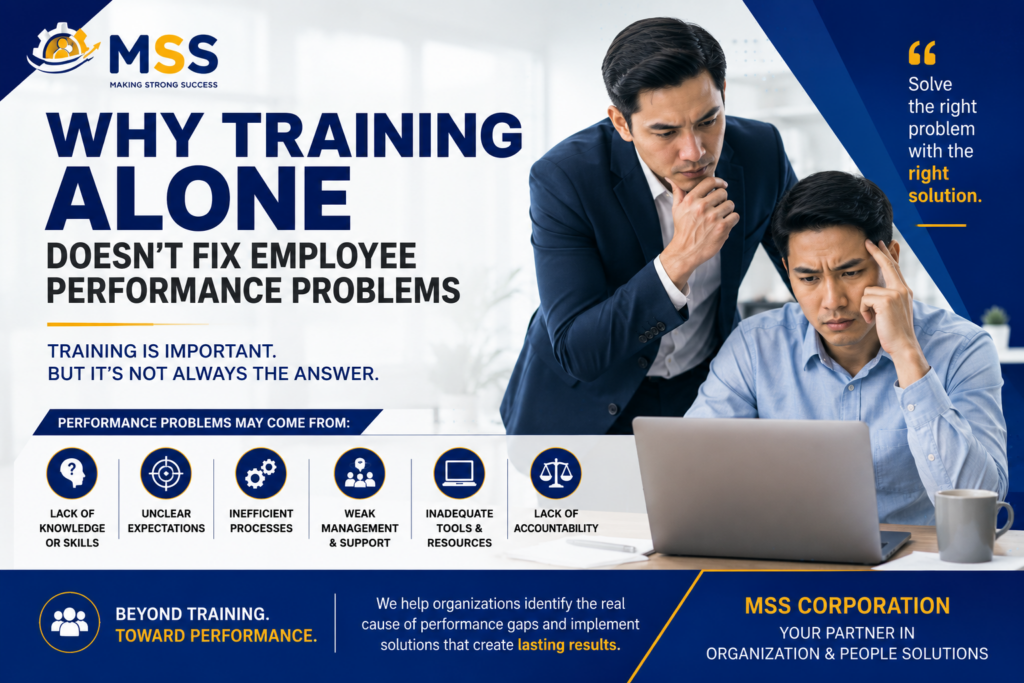
Organizations often turn to training when employees are not performing as expected.
Sales are declining? Conduct sales training.
Managers are struggling? Send them to leadership training.
Customer complaints are increasing? Schedule customer service training.
Productivity is falling? Run a productivity workshop.
Training can absolutely improve performance—but only when a lack of knowledge, skill, or capability is actually causing the problem.
When the real issue lies elsewhere, another seminar may give employees new information without changing the conditions preventing them from performing.
That is why effective organizations don’t begin with the question: “What training should we conduct?”
They begin with: “What is preventing our people from performing at the level the business requires?”
The Difference Between a Training Need and a Performance Problem
A training need exists when employees lack the knowledge, skills, behaviors, or capabilities required to perform effectively.
A performance problem is broader.
An employee may know exactly what to do and still struggle to deliver because of unclear expectations, inefficient processes, inadequate resources, conflicting priorities, weak supervision, poor job design, or organizational barriers.
Training addresses capability.
It cannot automatically repair every factor affecting performance.
Understanding this distinction can save organizations significant time, money, and effort.
Why Companies Sometimes Train the Wrong Problem
- Training is visible and relatively easy to implement.
- When a problem emerges, arranging a workshop can feel like immediate action.
- But consider an employee who repeatedly misses deadlines.
- Time-management training might appear to be the obvious solution.
- What if the employee is actually receiving conflicting priorities from three managers?
- What if an approval process adds several unnecessary days to every task?
- What if the employee’s workload is realistically beyond one person’s capacity?
- In these situations, training the employee harder does not remove the obstacle.
- The organization must address the cause behind the performance gap.
1. Employees Don’t Know How to Perform the Task
This is where training is highly appropriate.
If employees lack the required technical knowledge, interpersonal skills, leadership capability, or job-specific competencies, a well-designed training intervention can help close the gap.
The key is connecting learning objectives directly to the performance expected on the job.
2. Expectations Are Unclear
Employees cannot consistently achieve standards they do not understand.
Problems sometimes attributed to poor performance are actually caused by unclear responsibilities, vague targets, inconsistent instructions, or poorly defined KPIs.
Before training employees, leaders should confirm that people understand:
- What is expected
- Why it matters
- How performance will be measured
- Who is accountable
- What successful performance looks like
Clarity is a performance tool.
3. The Process Makes Good Performance Difficult
Even highly capable employees can struggle inside inefficient systems.
Complicated approvals, duplicated work, unclear handoffs, outdated procedures, and unnecessary administrative tasks can reduce productivity regardless of employee skill.
In this situation, process improvement may create greater performance gains than another training program.
4. Managers Are Not Reinforcing the Desired Behavior
Training ends. Workplace application begins.
Employees may leave a workshop motivated and equipped with new skills, only to return to an environment where their managers do not coach, reinforce, measure, or support those behaviors.
This creates a transfer gap between learning and performance.
Managers therefore play a critical role in converting training investments into business results.
5. Employees Lack the Right Tools or Resources
Performance expectations must match operational reality.
Employees may need better technology, sufficient manpower, reliable information, appropriate equipment, decision-making authority, or access to other resources.
Training someone to perform better while denying them the resources necessary to do the work creates frustration—not improvement.
6. Accountability Is Missing
Sometimes employees possess the capability, understand expectations, and have sufficient resources—but performance remains inconsistent because accountability is weak.
This may require stronger performance management rather than additional training.
Clear goals, regular feedback, coaching, measurement, recognition, and appropriate consequences help translate expectations into consistent performance.
Stop Asking “What Training Do We Need?”
A better question is: “What intervention will solve the performance problem?”
The answer might be training.
But it could also be:
- Coaching
- Process improvement
- Leadership development
- Role clarification
- Performance management
- Organizational restructuring
- Better tools or technology
- Policy improvement
- Workforce planning
And sometimes the solution requires several of these working together.
This is where an organization and people solutions approach becomes valuable.
From Training Provider to Performance Partner
Organizations receive greater value from learning and development when training is connected to actual business requirements.
Instead of measuring success only through attendance, satisfaction ratings, or certificates issued, organizations should examine whether employees apply what they learned and whether that application contributes to measurable performance improvement.
The objective isn’t simply to create trained employees.
It is to create better organizational performance.
How MSS Corporation Helps Organizations Improve Performance
MSS Corporation provides organization and people solutions designed to address both employee capability and the organizational conditions affecting performance.
MSS currently provides services spanning strategic HR consulting, workforce planning and talent optimization, performance management, leadership development, employee training and development, assessments, and organizational solutions.
This allows organizations to look beyond one-off interventions and determine what combination of training, consulting, coaching, systems, leadership, and people solutions can best address their needs.
Whether the challenge involves employee capability, management effectiveness, performance systems, workforce planning, or organizational processes, the goal should remain the same:
Solve the right problem with the right intervention.
Better Diagnosis Leads to Better Results
Training remains one of the most valuable investments an organization can make in its people.
But training creates the greatest impact when it addresses the right problem.
Before scheduling another program, organizations should understand the performance gap, identify what is causing it, and determine which intervention is most likely to create sustainable improvement.
Because sometimes your employees need training.
Sometimes your managers need coaching.
Sometimes your processes need redesigning.
And sometimes the organization itself needs to change.
Partner with MSS Corporation
If your organization is looking for a trusted partner in organization development, HR consulting, leadership development, and corporate training, MSS Corporation is ready to help.
Together, let’s build a workforce that is capable, confident, and future-ready.
If you enjoy reading, please visit our other articles for more interesting content.
To know more about Making Strong Success (MSS) Corporation, click our social media pages below: