360-Degree Feedback Training in the Philippines
Traditional performance appraisals often provide only one perspective—that of the immediate supervisor. While supervisors play a critical role in evaluating employee performance, they may not observe every leadership behavior, communication style, decision-making practice, teamwork interaction, coaching opportunity, customer relationship, or cross-functional collaboration demonstrated by the employee throughout the organization. As a result, organizations may overlook valuable developmental insights that can only be obtained from those who regularly work with the individual.
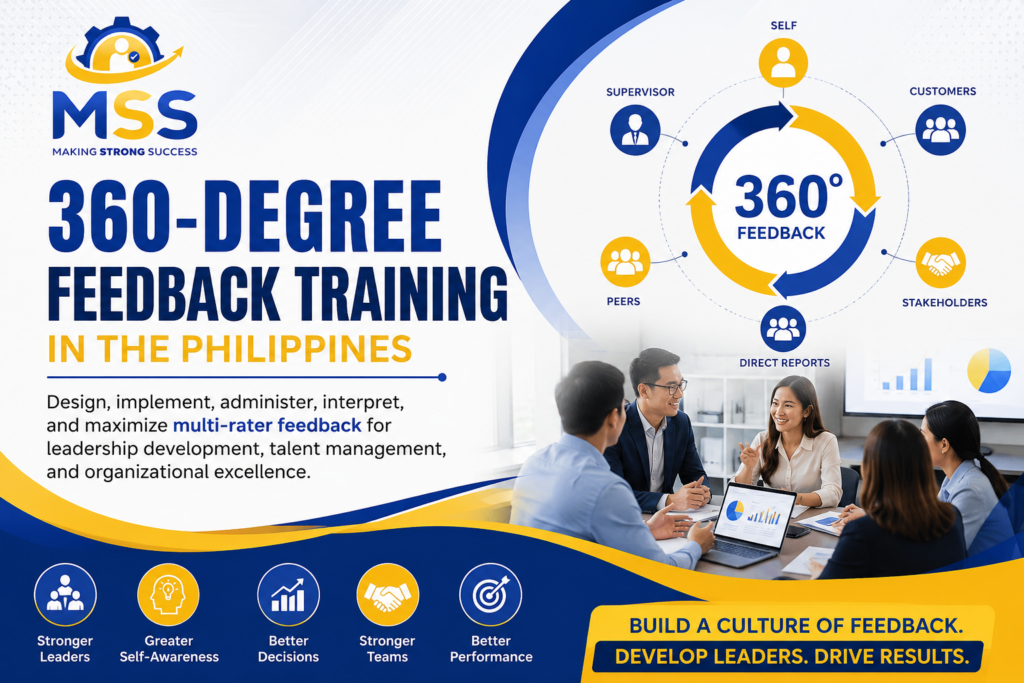
A properly designed 360-Degree Feedback System, also known as a 360-Degree Evaluation, Multi-Rater Feedback, or Multi-Source Feedback, gathers structured observations from supervisors, peers, direct reports, internal customers, external stakeholders, and self-assessments to provide a more balanced, objective, and comprehensive understanding of leadership effectiveness, workplace behaviors, interpersonal relationships, and professional competencies.
Our 360-Degree Feedback Training in the Philippines equips Human Resource professionals, Learning and Development practitioners, Organizational Development specialists, Talent Management professionals, executives, managers, supervisors, team leaders, internal facilitators, executive coaches, and company leaders with the practical knowledge and implementation tools needed to design, administer, interpret, and maximize an effective multi-rater feedback process that supports leadership development, employee development, succession planning, talent management, and organizational performance.
This practical and customizable 360-Degree Evaluation Training in the Philippines covers the complete feedback lifecycle, including defining assessment objectives, identifying leadership and behavioral competencies, developing competency-based questionnaires, selecting credible evaluators, orienting participants, protecting confidentiality, administering surveys, minimizing evaluator bias, analyzing quantitative ratings and qualitative comments, interpreting self-other perception gaps, identifying leadership blind spots, conducting developmental feedback conversations, preparing Individual Development Plans (IDPs), integrating coaching and mentoring, monitoring behavioral improvement, and sustaining a culture of continuous feedback and learning.
Participants also learn the important distinction between 360-Degree Feedback and traditional Performance Appraisal. Performance appraisal primarily evaluates what employees accomplish against established objectives, while 360-Degree Feedback evaluates how employees demonstrate leadership, communication, collaboration, accountability, professionalism, emotional intelligence, customer orientation, coaching, adaptability, and other observable workplace behaviors through multiple organizational perspectives. Understanding this distinction enables organizations to use both systems appropriately while reducing bias, increasing credibility, and strengthening employee acceptance of developmental feedback.
The program introduces the practical F.E.E.D.B.A.C.K.™ Framework, the proprietary MSS approach to implementing an effective multi-rater feedback process. Participants learn how to Frame the Purpose, Establish Competencies, Engage the Right Evaluators, Design the Assessment, Build Trust, Analyze Objectively, Coach for Growth, and Keep Improving to ensure that 360-degree feedback becomes a meaningful leadership development initiative rather than merely another employee survey.
Organizations implementing a 360-Degree Feedback Training in the Philippines frequently use the process to strengthen leadership development, management development, executive coaching, succession planning, competency assessment, talent reviews, employee development, organizational development, high-potential employee programs, performance management, coaching conversations, and organizational culture improvement. When supported by structured coaching and follow-through, multi-rater feedback can improve self-awareness, strengthen leadership effectiveness, enhance communication, increase accountability, identify development priorities, and support evidence-based learning and development investments.
Browse the embedded PDF training program outline below to review the learning objectives, detailed one-day training agenda, competency-mapping workshops, questionnaire development exercises, evaluator calibration activities, rating-bias simulations, feedback interpretation workshops, coaching role plays, Individual Development Planning (IDP) activities, organizational implementation planning sessions, expected participant outputs, delivery options, frequently asked questions, and customization opportunities available through Making Strong Success (MSS) Corporation.
To check out our other relevant training programs, click Human Resources Training Programs
To know more about Making Strong Success (MSS) Corporation, visit our social media pages on Facebook, LinkedIn, and Instagram.