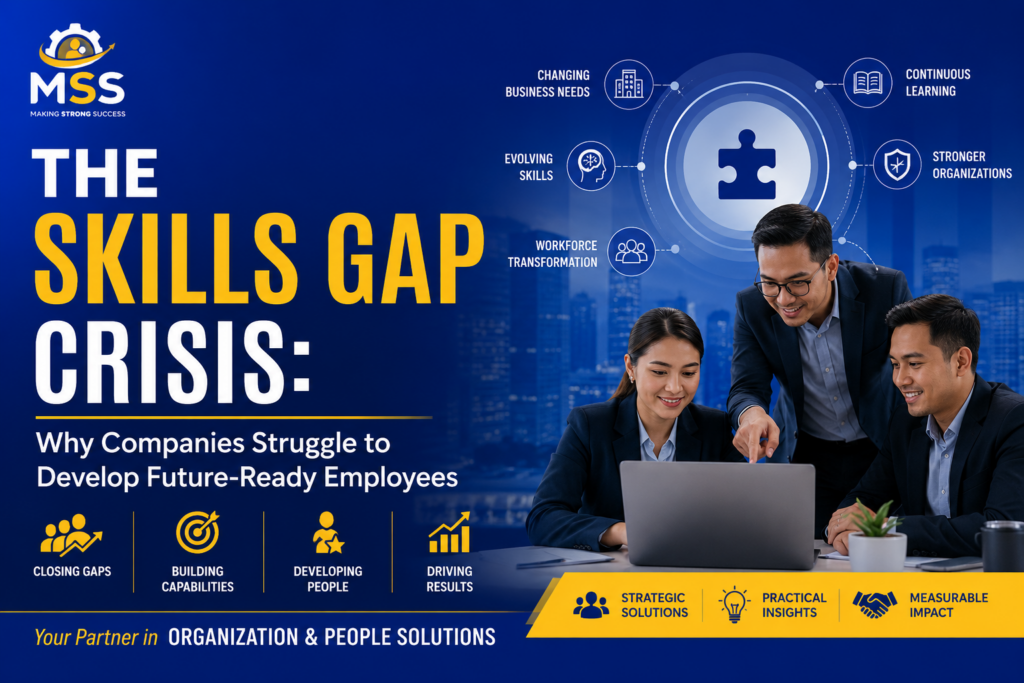
The Skills Gap Crisis: Why Companies Struggle to Develop Future-Ready Employees
In today’s rapidly evolving business environment, organizations are facing a challenge that can significantly impact productivity, competitiveness, and long-term growth—the skills gap.
While technology continues to advance, industries transform, and customer expectations evolve, many organizations find themselves with a workforce that lacks the skills required to meet current and future demands. The result is slower execution, reduced innovation, lower employee confidence, and missed business opportunities.
For business owners, executives, HR leaders, and managers, addressing the skills gap is no longer optional. It has become a strategic priority that directly influences organizational success.
Understanding the Skills Gap
A skills gap occurs when employees do not possess the competencies, knowledge, or behaviors required to perform their roles effectively or support the organization’s future direction.
The challenge is not always a lack of talent. In many cases, organizations hire capable individuals but fail to provide structured development opportunities that align employee capabilities with business objectives.
As markets become more competitive, companies must continuously assess whether their workforce is equipped to meet emerging challenges.
Common indicators of a skills gap include:
- Declining productivity
- Increased workplace errors
- Difficulty adapting to new technologies
- Poor customer experiences
- Leadership succession challenges
- Low employee confidence and engagement
- Delays in project execution
When these issues persist, organizations often experience increased turnover, reduced profitability, and slower growth.
Why Many Organizations Struggle to Close the Skills Gap
1. Training Without Strategic Direction
Many companies conduct training programs simply because they have a budget to spend or because training has become an annual requirement.
Without a clear connection between learning initiatives and organizational goals, training often fails to create meaningful change.
Organizations need development programs that address specific business challenges and competency requirements.
2. Lack of Competency-Based Development
Effective workforce development begins with understanding the competencies required for success.
When organizations fail to identify skill gaps accurately, learning investments become reactive rather than strategic.
Competency-based development helps ensure that employees receive the right learning interventions at the right time.
3. Rapid Business and Technology Changes
The skills that were relevant five years ago may no longer be sufficient today.
Organizations must continuously prepare employees for:
- Digital transformation
- Process improvements
- Leadership responsibilities
- Customer experience expectations
- Data-driven decision making
- Cross-functional collaboration
Future-ready organizations understand that workforce development is an ongoing process rather than a one-time event.
4. Limited Leadership Development
Many organizations focus on technical skills while overlooking leadership capabilities.
As employees advance into supervisory and managerial roles, they require new competencies in communication, coaching, decision-making, conflict management, and strategic thinking.
Without leadership development, organizations often struggle to build a sustainable talent pipeline.
The Business Impact of Closing the Skills Gap
Organizations that proactively address workforce capability development experience several advantages:
Improved Productivity
Employees who possess the right skills perform tasks more efficiently and produce higher-quality outcomes.
Stronger Employee Engagement
People are more engaged when they feel competent, confident, and supported in their professional growth.
Better Retention
Employees are more likely to stay with organizations that invest in their development and career progression.
Enhanced Agility
Organizations with highly skilled employees can respond faster to market changes, customer demands, and business challenges.
Sustainable Growth
A future-ready workforce enables organizations to scale operations, innovate, and maintain competitive advantage.
Building a Future-Ready Workforce
Addressing the skills gap requires a structured and strategic approach.
Assess Current Capabilities
Begin by identifying existing competencies, performance gaps, and future workforce requirements.
Align Learning with Business Goals
Development initiatives should support organizational priorities rather than operate independently.
Create Development Pathways
Employees should have clear learning and growth opportunities that prepare them for future responsibilities.
Develop Leaders at Every Level
Leadership development should not be limited to senior executives. Future leaders can be found throughout the organization.
Measure Learning Impact
Organizations should evaluate how development programs influence performance, productivity, engagement, and business results.
How MSS Corporation Helps Organizations Close the Skills Gap
At MSS Corporation, we believe that organizational success begins with people.
As a trusted organization and people solutions company, we help businesses build future-ready workforces through customized training, consulting, coaching, leadership development, competency assessment, and organizational development solutions.
Our approach focuses on aligning people strategies with business objectives to ensure that learning initiatives produce measurable and sustainable results.
Whether your organization is looking to strengthen leadership capabilities, improve employee performance, develop training roadmaps, or create a high-performance culture, MSS Corporation provides practical and strategic solutions tailored to your needs.
The Future Belongs to Organizations That Invest in People
The skills gap is not simply an HR challenge—it is a business challenge.
Organizations that invest in workforce development today will be better positioned to innovate, adapt, and grow tomorrow.
The question is no longer whether organizations should develop their people. The real question is whether they can afford not to.
Partner with MSS Corporation
If your organization is looking for a trusted partner in organization development, HR consulting, leadership development, and corporate training, MSS Corporation is ready to help.
Together, let’s build a workforce that is capable, confident, and future-ready.
If you enjoy reading, please visit our other articles for more interesting content.
To know more about Making Strong Success (MSS) Corporation, click our social media pages below: